


Categorization:Harness Component
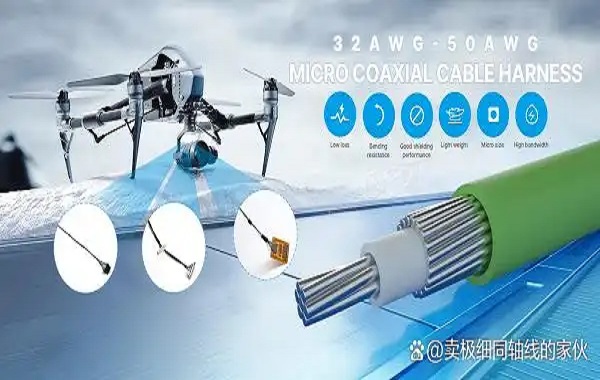
Structure characteristics comparison
Extremely thin coaxial cables have a very small diameter, consisting of a central conductor, an insulating layer, and a shielding layer. They have controllable impedance and strong shielding performance, suitable for high-speed data and radio frequency signal transmission. At the same time, they have high flexibility and can withstand multiple bends without affecting performance. FFC is composed of parallel conductors and flexible insulating materials, with a flat shape, light weight, and low cost. It is easy to install and suitable for board-to-board fixed connections, but lacks a shielding layer and has limited resistance to electromagnetic interference.
Differences in the application of drones
Extremely thin coaxial cables can meet the high-speed data requirements of drone transmission modules, high-definition cameras, and sensors, ensuring signal integrity and being suitable for parts that require frequent bending, such as gimbals or folding structures. The advantage of FFC lies in its lightweight and low cost, making it suitable for fixed circuits or auxiliary modules, and it can still provide sufficient performance in low-speed signal transmission scenarios. Both have their own focuses, and can be selected according to functions and requirements.
Section 3: Selection Reference and Design Approach
In scenarios where high speed and stability are prioritized, such as video links and radio frequency modules, extremely thin coaxial cables are more suitable. In scenarios where lightweighting and low cost are prioritized, such as fixed control circuits or auxiliary modules, FFC (Flexible Flat Cable) has more advantages. In actual drone design, a mixed usage strategy is often adopted, combining the advantages of both types of cables to ensure signal stability of key components while also considering the overall weight and cost, achieving the best balance between performance and efficiency.
“Without the consent or authorization of this site, no one shall reproduce, reprint, distribute, cite, change, broadcast or publish the content in whole or in part in any form, nor shall there be any other violation of the copyright of this site.