


Categorization:Harness Component
With the development of robots towards miniaturization, lightweight, high degrees of freedom, and high-speed motion, the space available for wiring within the joints is increasingly limited. At the same time, functions such as vision, position feedback, sensors, and high-speed data communication are increasing, requiring more signal channels to be accommodated within the limited space. For engineers, the wiring within the robot joints cannot only meet the requirement of "being able to connect" but also needs to take into account factors such as wire diameter, wiring density, bending space, connector height, high-speed signal integrity, and long-term motion reliability. Extremely thin coaxial cables have characteristics such as fine wire diameter, high signal channel density, and suitability for high-frequency high-speed signal transmission, making them a candidate for evaluating internal wiring within robot joints from the perspectives of size and high-speed signal interconnection. However, it should be especially noted that robot joints are dynamic bending applications, and whether they are ultimately applicable cannot be judged solely based on the product category of "extremely thin coaxial." It is necessary to verify this by combining actual bending radius, number of motion cycles, drag chain/twisting method, fixed structure, and the bendability of the wire material itself.
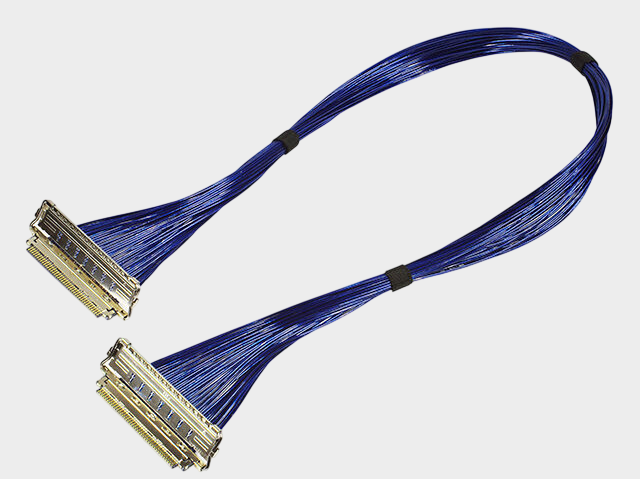
This product corresponds to the ultra-fine coaxial cable assembly product number/model I-PEX 82669-100B-01-D, which belongs to CABLINE®-CA II 30P HARNESS, using 30Pin, 40AWG Micro-Coaxial ultra-fine coaxial cable, 200MM length, and 1-1 double-ended connection structure. The cable end connector model used on this ultra-fine coaxial cable assembly is 20680-030T-01. For robot research and development engineers, the high-density 30Pin connection form can concentrate on multi-channel signal connections in limited space, while the 40AWG ultra-fine coaxial cable is conducive to reducing the space occupied by the cable assembly; the 200MM standard length can serve as a reference for internal wiring design of robot modules. At the same time, the CABLINE®-CA II series adopts 0.4mm Pitch, horizontal connection, and ZenShield® full shielding design, positioning in high-density, high-speed signal connection scenarios. Therefore, if there are high-speed data, vision, sensor, or display signals inside the robot joint, this type of ultra-fine coaxial cable assembly has further evaluation value.
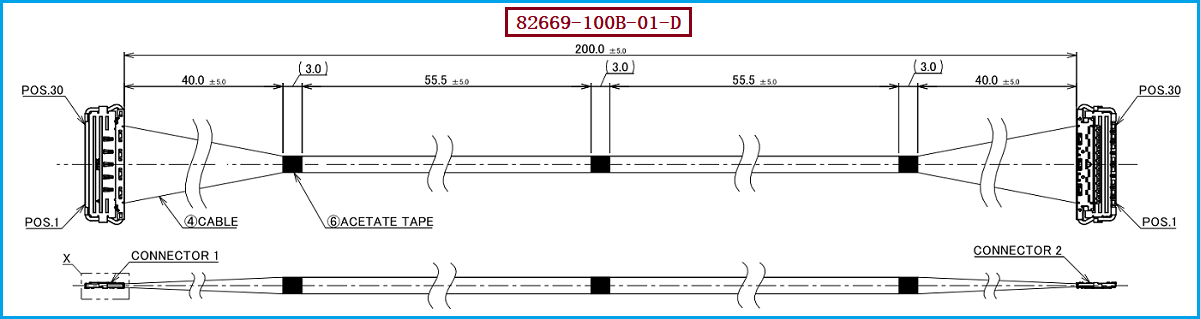
The biggest difference between robot joints and ordinary static electronic devices lies in the continuous bending, swinging, and even twisting of the cables as the joints move. Therefore, for engineers, the key to determining whether a very thin coaxial cable is suitable for robot joints cannot be just the wire diameter and Pin number, but should focus on verifying the dynamic life. For example, what is the minimum bending radius allowed by the actual mechanical structure, whether the cables have repeated bending during the joint movement, whether there is axial twisting, whether there is stress concentration at the cable fixing points, and whether the conductors, insulation layers, shielding layers, and connector terminations still maintain stability after a large number of movement cycles. In other words, 82669-100B-01-D can be used as a reference alternative for high-density internal high-speed interconnection in robot joints, but it cannot be directly claimed as suitable for all robot joints without dynamic life verification. For purchasers, it is also recommended to require suppliers to provide actual wire material structure, termination technology, bending test, and life verification plan at the stage of supplier introduction, rather than simply replacing procurement based on the connector appearance.
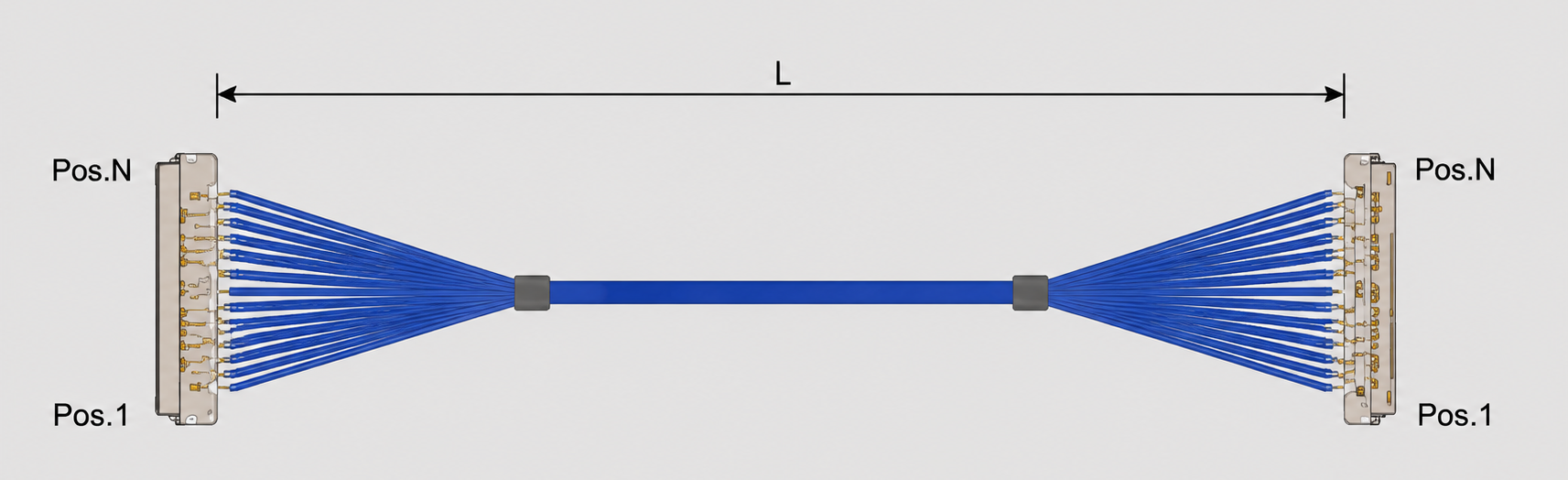
If the project plans to apply ultra-fine coaxial cable bundles to robot joints, it is recommended to first confirm the installation space, movement trajectory, minimum bending radius, number of motion cycles, signal type, transmission speed, cable length, and connector installation direction of the robot joint, and then proceed with specific selection. The reference specification for this product is I-PEX 82669-100B-01-D, 30Pin, 40AWG, 200MM, 1-1, with the cable end connector model being 20680-030T-01; if the robot project requires changes to cable length, pin count, connection method, or wire exit direction, then a new specification matching and dynamic reliability verification should be conducted. In response to the domestic substitution demand for the original factory's ultra-fine coaxial cable bundles, our company can provide: I-PEX 82669-100B-01-D compatible substitution cable solution, which can be adapted for development and production according to the actual structure of the customer's robot module, for ultra-fine coaxial cable material, connector termination, cable length, and assembly requirements. For procurement personnel, it is recommended to proceed with verification of dimensions, conductivity, appearance, termination reliability, and dynamic bend after using the original factory samples and engineering drawings as a baseline; for engineers, it is suggested to synchronize the verification of high-speed signals and mechanical movement lifespan in the initial design phase.
“Without the consent or authorization of this site, no one shall reproduce, reprint, distribute, cite, change, broadcast or publish the content in whole or in part in any form, nor shall there be any other violation of the copyright of this site.