


Categorization:Harness Component
With the continuous development of industrial cameras, machine vision, high-speed cameras, AI vision terminals, and high-resolution image acquisition equipment towards high frame rates, high resolutions, and high-speed data transmission, the amount of data that needs to be transmitted internally within the image acquisition module is increasing. At the same time, the internal space of the device is becoming more compact. Traditional wiring and ordinary multi-core cables may face issues such as impedance control, crosstalk, EMI electromagnetic interference, and spatial wiring during high-speed signal transmission. Therefore, extremely thin coaxial cables have gradually become an important solution for high-speed signal connections within high-speed image acquisition modules. Taking the I-PEX 82678-100B-01-D introduced this time as an example, the product belongs to the CABLINE®-UM series 40Pin extremely thin coaxial cable, using 40AWG Micro-Coaxial Cable, both ends are equipped with connectors, wire position defined as 1-1, standard length of 200mm. Its matching cable end connector model is 20878-040T-01. For engineers, this combination of "extremely thin coaxial cable + high-speed connector" not only meets the requirements of miniaturization and high-density wiring but also helps to maintain a more stable signal environment during high-speed image data transmission; for purchasers, clearly defining part number, Pin count, wire gauge, length, connection method, and connector model is an important foundation for selection, replacement, and supply chain management.
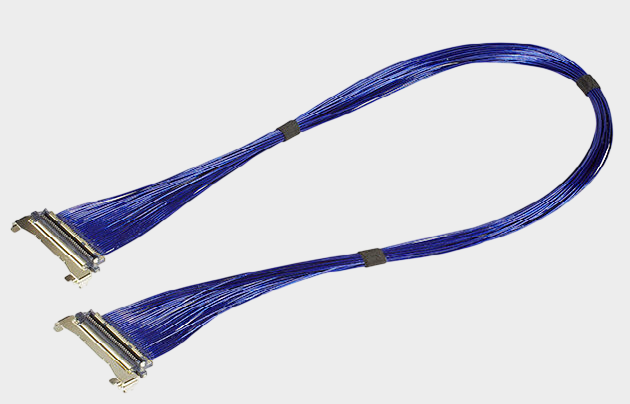
In high-speed image acquisition systems, EMI optimization cannot be solely focused on connectors or merely selecting finer wire materials. It should be considered from a holistic perspective, including "connectors + ultra-fine coaxial cables + shielding + grounding + wiring." CABLINE®-UM utilizes a 0.4mm ultra-fine contact spacing, Vertical Right Angle straight structure, and is equipped with ZenShield® full shielding design and mechanical locking structure, allowing for high-density, high-speed connections within limited device space. For image acquisition modules, the ultra-fine coaxial cables themselves have independent coaxial shielding structures, which can reduce the electromagnetic radiation generated by high-speed signals in the surrounding space while also lowering the impact of external noise on high-speed signals; the connector end further improves EMC performance through full shielding and multi-point grounding design. When industrial cameras or high-speed vision modules coexist with image sensors, high-speed processing chips, clock circuits, power conversion circuits, and wireless communication modules, reasonably selecting ultra-fine coaxial cable bundles with good shielding performance and impedance control capabilities can reduce the risk of mutual interference between high-speed signals. Especially in high-speed interface applications such as USB4, Thunderbolt, DisplayPort, eDP, MIPI, engineers should focus on characteristic impedance, insertion loss, reflection loss, crosstalk, shielding continuity, and connector grounding structure during selection, rather than just using "AWG wire diameter" and "Pin number" as the criteria. For high-speed ultra-fine coaxial cable bundles like I-PEX 82678-100B-01-D with 40 Pins, 40AWG, 200mm, 1-1 structure, reasonably matching the impedance and EMI design of the high-speed signal system is an important link for stable image data transmission.
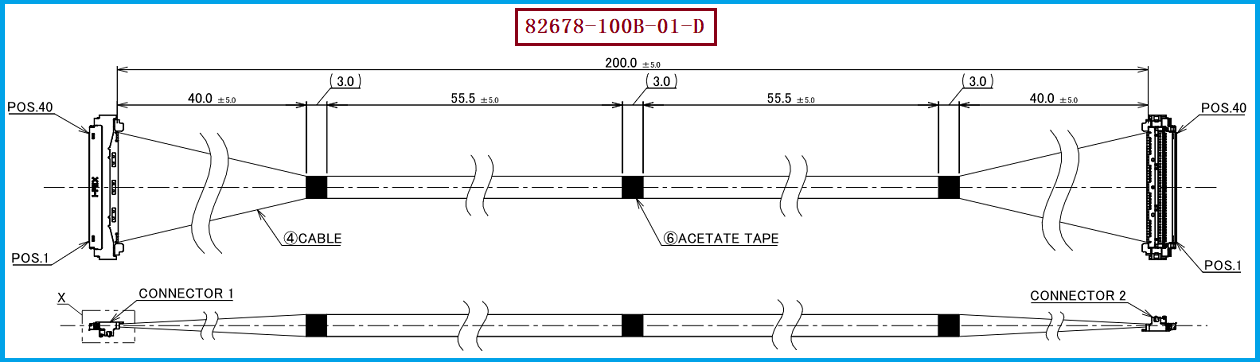
From the perspective of engineering applications, I-PEX 82678-100B-01-D can be understood as a "40Pin+40AWG+200mm+1-1" CABLINE®-UM ultra-thin coaxial cable assembly solution, where the connector model used at the cable end is 20878-040T-01, and the wire position is defined as 1-1, meaning that corresponding connections are made at both ends of the cable assembly, suitable for end-to-end high-speed signal connections between two high-speed modules, PCBs, or interfaces. The CABLINE®-UM connector uses a 0.4mm pitch design, supports 30Pin, 40Pin, 50Pin, 60Pin, and other specifications, and has the high-speed transmission capability of up to 40Gbps/lane PAM3. It also supports high-speed applications such as USB4 Gen4, Thunderbolt 5, DisplayPort UHBR20, V-By-One US, HDMI, eDP, and MIPI. For high-speed image acquisition modules, engineers should check the connector pin count and pad layout, connector shape and installation space, cable length, wire position definition, ultra-thin coaxial cable specifications, impedance parameters, shielding structure, and actual high-speed signal integrity when conducting alternative design. Purchasing personnel should pay special attention to the BOM correspondence between the original manufacturer's part number and the alternative part number, connector model, cable specification, processing length, terminal reliability, and batch consistency. Only when mechanical, electrical, high-frequency performance, and production processes can match, can stable and reliable compatibility and replacement be truly achieved, rather than simply "the interface can be plugged in."
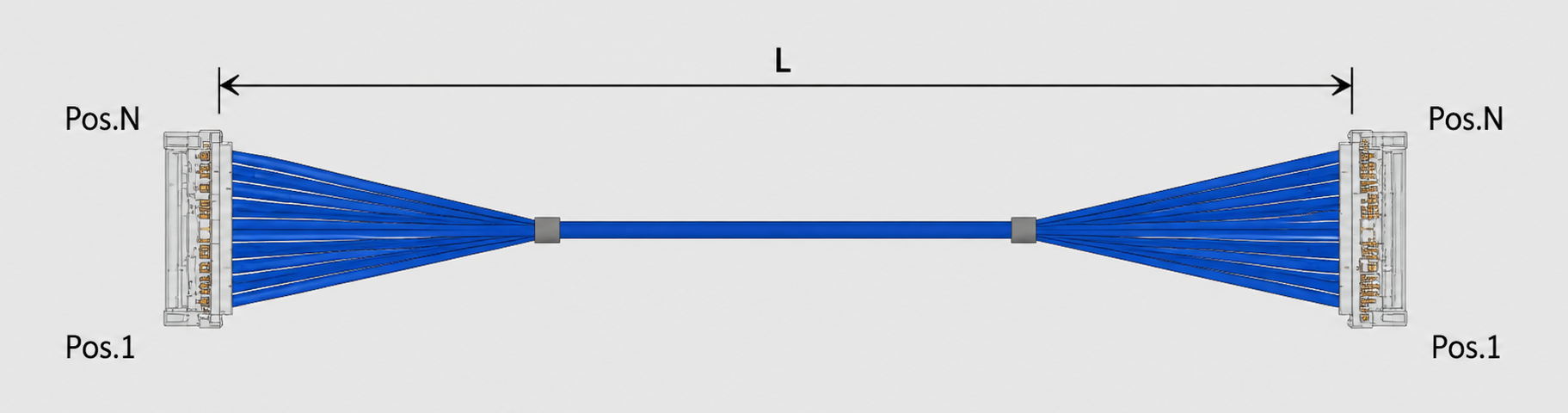
For high-speed image capture modules requiring the I-PEX 82678-100B-01-D, if there is a need for domestic substitution, supply chain optimization, shortened delivery times, or cost control, a compatible alternative solution can be established around the core specifications of the original product. Firstly, the 40Pin, 40AWG, 200mm, 1-1 line position definition, and the 20878-040T-01 connector should be used as the basic matching conditions. Then, according to the actual high-speed protocol and transmission rate of the equipment, the characteristic impedance, attenuation, shielding performance, and signal integrity of the extremely fine coaxial cable should be verified. For industrial vision, machine vision, and high-speed camera equipment with high EMI requirements, it is also necessary to focus on verifying the continuity between the shielding layer of the cable harness and the metal structure of the connector, as well as the EMC performance after the overall assembly. In the actual substitution process, it is recommended that the engineering team conduct systematic verification of the alternative cable harness through sample prototyping, impedance testing, high-speed eye diagram testing, S-parameter testing, crosstalk testing, EMI/EMC testing, and reliability testing. For the procurement department, it can require suppliers to provide specifications confirmation, connector matching instructions, and sample testing support corresponding to the I-PEX 82678-100B-01-D. Our company can provide: I-PEX 82678-100B-01-D compatible alternative cable harness solutions. According to the actual structural requirements of customers' high-speed image capture modules, industrial cameras, machine vision equipment, and other high-speed electronic devices, we can carry out compatible development and production of extremely fine coaxial cable harnesses around the 40Pin, 40AWG, 200mm, 1-1, and 20878-040T-01 connector configurations. We provide cable harness alternative support from sample verification to mass production for engineers.
“Without the consent or authorization of this site, no one shall reproduce, reprint, distribute, cite, change, broadcast or publish the content in whole or in part in any form, nor shall there be any other violation of the copyright of this site.