


Categorization:Harness Component
For laptops, display modules, AI terminals, industrial vision equipment, and high-speed computing equipment, the internal space is continuously shrinking, but the transmission rate of high-speed signals is continuously improving. Therefore, extremely thin coaxial cables have become an important connection solution that balances high-density wiring and high-speed signal integrity. The I-PEX 82285-100B-02-D discussed in this article belongs to the CABLINE®-UM series 50Pin, 40AWG, 200MM, 1-N Pin Assignment ultra-thin coaxial cable evaluation specification. The mating connector model for the cable end is 20878-050T-01. CABLINE®-UM uses a 0.4mm Contact Pitch and Vertical Right Angle structure, and supports the highest 40Gbps/lane PAM3 high-speed transmission. It also adopts ZenShield® full EMI shielding and mechanical locking design. Therefore, in the internal interconnection of high-speed, high-density, and miniaturized equipment, it puts forward higher requirements for the signal integrity, shielding performance, impedance consistency, and processing reliability of the cable itself. For engineers, when selecting such cables, they cannot only focus on the number of pins, length, and connector model, but also need to pay close attention to various interference issues that may occur during the high-speed signal transmission process.
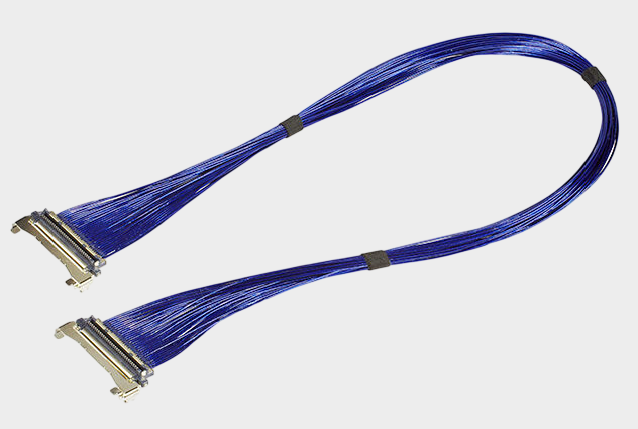
Extremely thin coaxial cables, although with an independent shielding structure, still require the analysis of signal interference from the entire interconnect chain in actual high-speed applications. Firstly, there is the issue of crosstalk, where when multiple high-speed signal lines are densely arranged in a very small space, electromagnetic coupling may occur between adjacent channels, leading to near-end or far-end crosstalk, ultimately manifesting as signal waveform distortion, increased noise, and a rising risk of error at the receiving end. Secondly, there is external EMI interference and signal leakage. High-speed signals themselves generate high-frequency electromagnetic energy, and if there are discontinuities in the cable shielding layer, connector shielding structure, or grounding path, electromagnetic leakage may occur, and it is also susceptible to interference from surrounding power supplies, clocks, and other high-speed devices. In addition, impedance discontinuity is a problem that engineers often need to pay attention to, especially at the cable, terminal, connector, and PCB transition positions. If there are significant changes in structural dimensions, insulating medium, or conductor geometric relationships, reflections may occur, affecting the high-speed signal eye diagram and transmission quality. Therefore, extremely thin coaxial cables cannot be simply understood as "connecting wires together," but should be treated as part of the high-speed signal chain and be designed and verified as a whole.
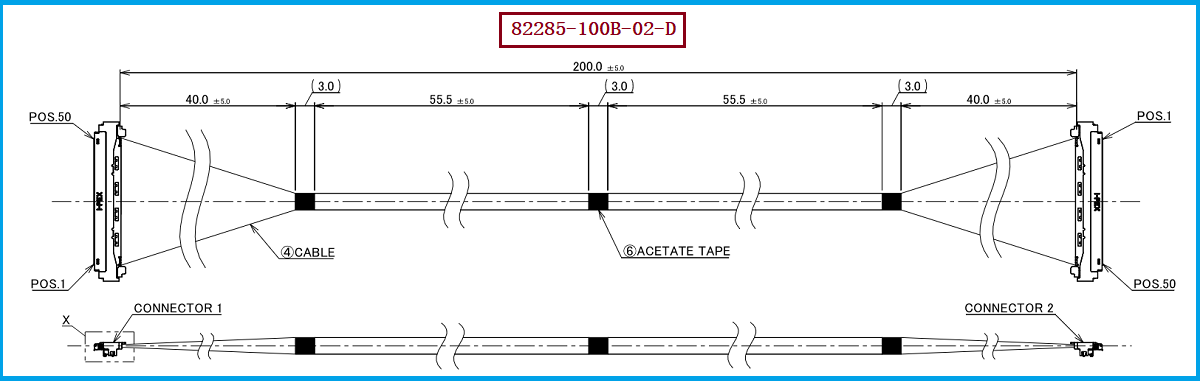
For coaxial cable assemblies like I-PEX 82285-100B-02-D with 50 pins, 40AWG, and 200MM thickness, the manufacturing accuracy of the wire material directly affects the high-speed transmission performance. The internal conductor, insulation layer, shielding layer, and outer sheath of the ultra-thin coaxial cable have a clear electrical structure relationship. The conductor size and roundness, dielectric properties and thickness of the insulation material, shielding layer coverage, and grounding continuity all affect characteristic impedance, attenuation, crosstalk, and signal reflection. Especially under ultra-thin wire diameters like 40AWG, the proportion of manufacturing tolerances is more obvious. If the structural consistency of the wire material in different batches or different positions is insufficient, it may cause fluctuations in high-speed signal parameters. Therefore, for engineers, the replacement cable assembly cannot merely pursue "the connector can be plugged in," but should focus on confirming that Pin Assignment, wire diameter, wire material structure, impedance requirements, shielding method, termination process, and overall dimensions match the original design; for purchasers, it is necessary to pay attention to whether the supplier has a stable manufacturing capability for ultra-thin coaxial cable assemblies and whether the consistency and delivery stability of the product can be maintained during mass production.
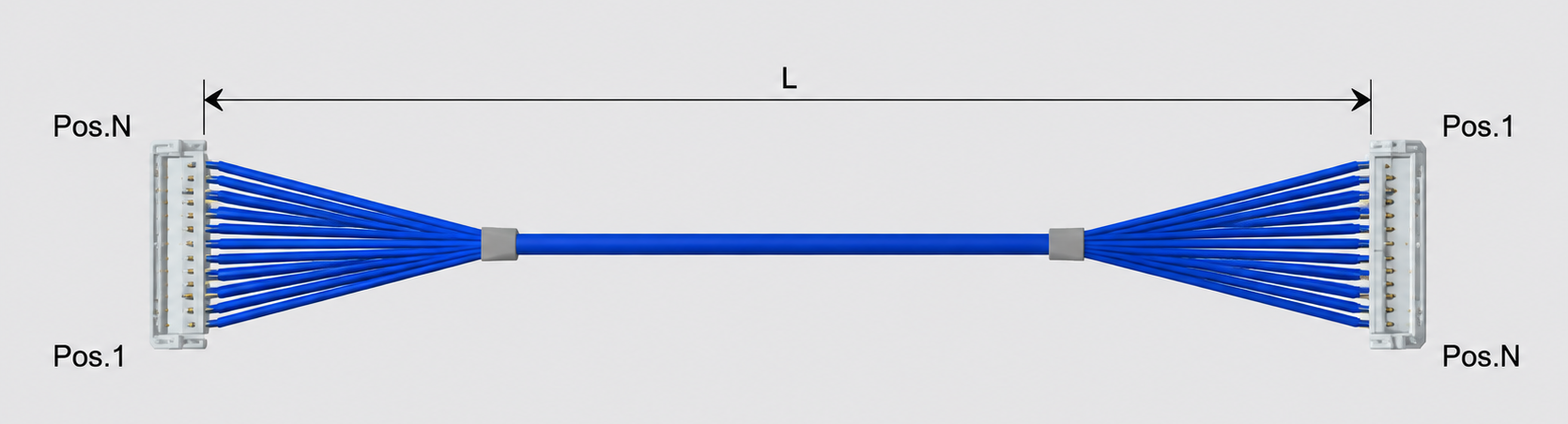
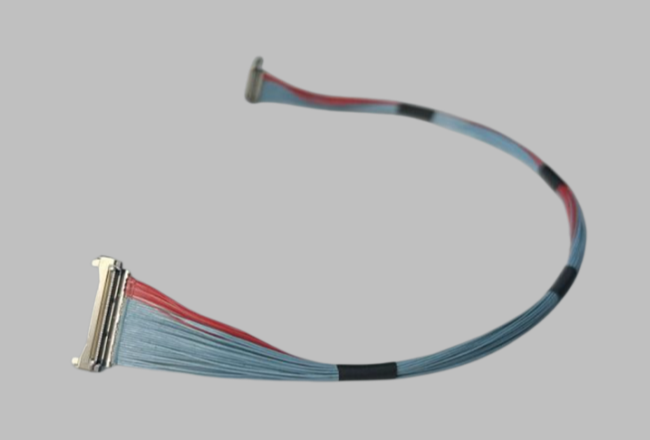
When selecting a compatible or alternative option for I-PEX 82285-100B-02-D, engineers are advised to first take the original cable's 50Pin, 40AWG, 200MM, and 1-N Pin Assignment as the basic condition. At the same time, they should check the matching relationship of the cable end connector 20878-050T-01, and further confirm the PCB end connector, Pin definition, wire sequence, wire exit direction, cable outer diameter, shielding structure, and high-speed signal requirements. Since CABLINE®-UM belongs to a 0.4mm ultra-fine pitch high-speed connection solution, even if the alternative products are similar in appearance, it does not necessarily mean that they can achieve electrical compatibility directly. Therefore, it is recommended to conduct targeted verification of impedance, insertion loss, return loss, crosstalk, shielding continuity, and high-speed signal integrity at the sample stage. For purchasers, if there are pressures on price, delivery time, supply stability, or customization flexibility for the original cable, they can consider finding manufacturers with mature ultra-fine coaxial cable production processes for compatibility and alternative development. Our company can provide I-PEX 82285-100B-02-D compatible and alternative cable solutions, which can be matched and developed around the original product's 50Pin, 40AWG, 200MM, and connector configuration, and provide engineers with ultra-fine coaxial cable solutions for sample verification and mass production introduction.
“Without the consent or authorization of this site, no one shall reproduce, reprint, distribute, cite, change, broadcast or publish the content in whole or in part in any form, nor shall there be any other violation of the copyright of this site.