


Categorization:Harness Component
In high-speed cameras, displays, AI vision, industrial equipment, and compact electronic products, ultra-fine coaxial cables not only serve as signal connections but are also directly related to high-speed signal integrity. Engineers often encounter a key parameter when selecting ultra-fine coaxial cables——characteristic impedance. So, what are the common impedance values of ultra-fine coaxial cables? From the actual application of high-speed electronic devices, 50Ω and 100Ω are relatively common impedance design targets. The 50Ω ultra-fine coaxial cable is often used for single-ended high-speed signals and some high-speed internal interconnect schemes, while differential signal chains frequently involve 100Ω differential impedance design. It should be noted that the nominal impedance of the cable material alone cannot determine the entire chain's high-speed performance. Connectors, PCB routing, termination structures, and cable length all have a combined effect on signal integrity. Therefore, for engineers, when selecting, they cannot just look at "AWG how many" but also confirm the target impedance and the impedance matching of the entire high-speed chain.
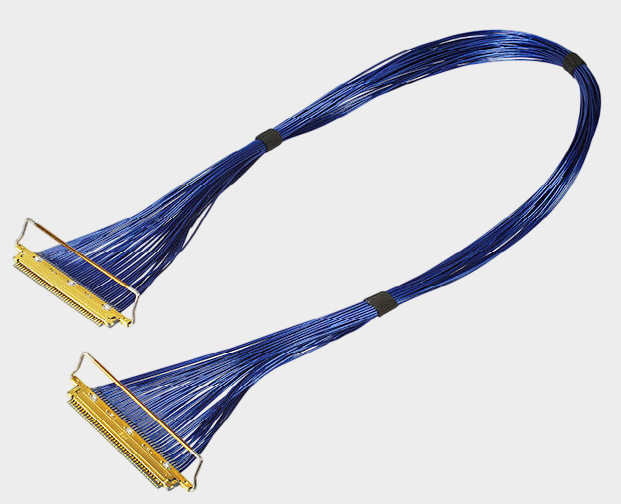
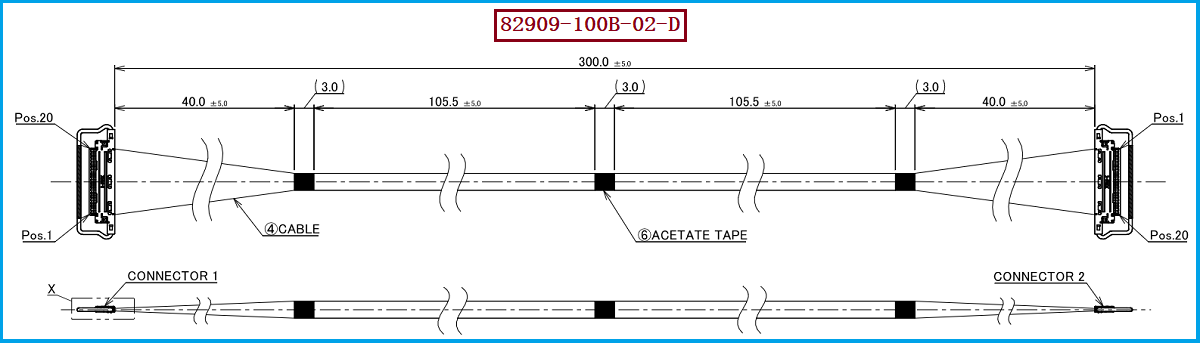
The product number/model introduced this time is I-PEX 82909-100B-02-D, which belongs to the CABLINE®-VS 20P HARNESS ultra-fine coaxial cable solution. According to the corresponding engineering drawing, this product uses 20 Micro-Coaxial Cable ultra-fine coaxial cables, with wire specifications of AWG#40, characteristic impedance of 50Ω, cable length of 300.0±5.0mm, and 1-N wire sequence. The connector model used at the wire end is 20454-220T, which matches the 20PIN high-density connector structure. For high-speed signal transmission, 50Ω is not a parameter that can be ignored; it means that the wire material needs to control the size of the center conductor, the dielectric layer structure, the shielding layer, and the geometric relationship between each layer during design. If the wire material impedance deviates from the design target, reflections may occur during the transmission of signals between the connector, wire material, and PCB, which can affect the eye diagram, insertion loss, return loss, and ultimately the stability of data transmission. Therefore, AWG#40 and 50Ω need to be confirmed as an overall specification, and cannot be used as a substitute only based on "40AWG wire material."
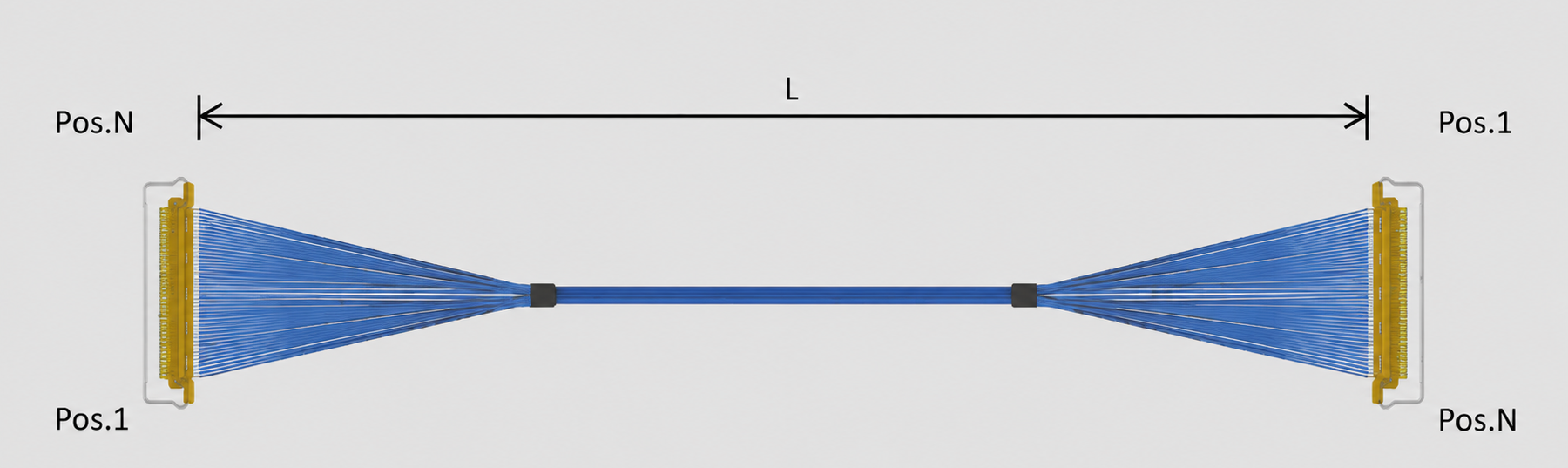
The characteristic impedance of ultra-fine coaxial lines is not simply determined by the wire diameter. It is closely related to the size of the center conductor, the dielectric material's dielectric constant, the thickness of the insulating layer, the structure of the shielding layer, and the geometric distance between the conductor and the shielding layer. For example, when the size of the center conductor remains similar, changing the dielectric layer material or thickness can lead to changes in impedance; consistency in shielding structure and production process will also affect the impedance stability of the entire cable assembly. For engineers, if the original equipment design requires 50Ω, the alternative cable should be structured to match the 50Ω target, and further confirmation of impedance consistency should be obtained through methods such as TDR, while combining actual high-speed interface tests for eye diagrams, crosstalk, and losses. For purchasers, when judging alternative products, they should not only compare surface parameters such as "AWG#40, 20PIN, 300mm," but also require suppliers to confirm impedance specifications, connector models, wire sequence, length tolerance, and high-speed signal testing capabilities to reduce the risk of redesign due to parameter mismatch.
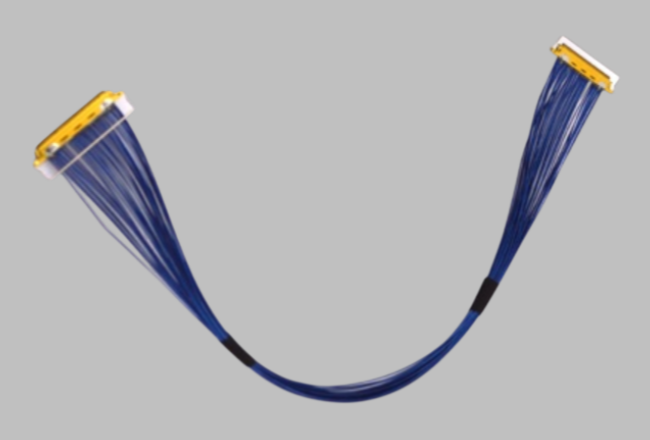
If it is necessary to replace I-PEX 82909-100B-02-D with a domestic alternative, it is recommended to first lock in the core specifications: 20PIN, AWG#40, 50Ω Micro-Coaxial Cable, 300±5mm, 1-N wire sequence, and the 20454-220T connector scheme. Then, confirm the appearance, wire direction, end dimensions, fixing method, and actual PCB mating connector of both ends. It should be particularly noted that although CABLINE-VS and CABLINE®-CA both belong to I-PEX ultra-fine coaxial connector solutions, their Pitch, connector structure, and specific material numbers are different, so they cannot be simply interchanged based on pin count or wire diameter. Our company can provide: I-PEX 82909-100B-02-D compatible alternative cable assembly solutions. We can produce and manufacture ultra-fine coaxial cable assemblies and compatible alternative developments based on the samples, drawings, or technical requirements provided by customers, around 20454-220T, AWG#40, 50Ω, 20PIN, 300±5mm, and 1-N wire sequence. For high-speed application projects, it is recommended to focus on verifying impedance consistency, connector matching, insertion/removal reliability, signal integrity, and actual equipment assembly dimensions at the sample stage, and then proceed with bulk procurement based on the verification results.
“Without the consent or authorization of this site, no one shall reproduce, reprint, distribute, cite, change, broadcast or publish the content in whole or in part in any form, nor shall there be any other violation of the copyright of this site.