


Categorization:Harness Component
For engineers, "how fine can the thinnest coaxial cable bundle be" cannot be answered simply with a number because the finer the wire diameter, the higher the requirements for conductor size, insulating layer, shielding layer, characteristic impedance, mechanical strength, and connector crimping/welding technology. Taking the I-PEX CABLINE®-UX II series as an example, its connectors adopt a 0.25mm Pitch ultra-narrow pitch design, which can match AWG44, AWG46 and other Micro-Coaxial extremely fine coaxial cables, already belonging to a very miniaturized internal high-speed connection solution. For practical projects, engineers should focus more on "how fine can it be under the premise of meeting signal integrity and reliability" rather than simply pursuing the minimum outer diameter. While a finer wire diameter can save more space in the shaft, screen bezel, and internal equipment, it will also put higher requirements on processing precision, bend life, and mass production consistency.
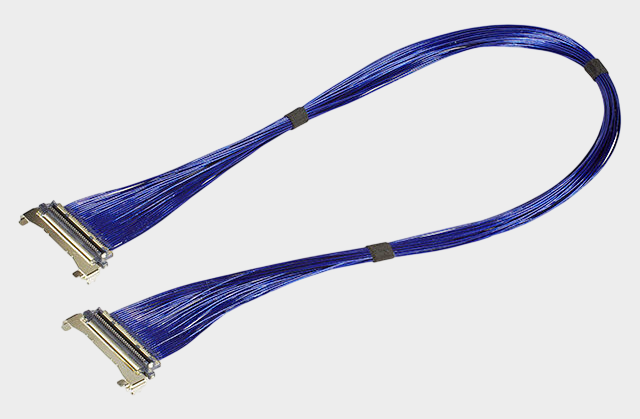
This product corresponds to the model I-PEX 83051-100B-01-D, which belongs to the CABLINE®-UX II 34P ultra-thin coaxial cable assembly. It uses Micro-Coaxial AWG #46, 50Ω wire material, with a finished length of 300MM. Both ends are connected using a 1-1 Pin-to-Pin connection method, and the connector model used at the wire end is 20532-034T-02-1, accompanied by the corresponding 34P connector structure. For engineers, the value of this AWG46 ultra-thin coaxial cable assembly is not just that "the wire is very thin," but rather the ability to simultaneously achieve multi-channel high-speed signal transmission and flexible wiring in a limited space. Especially in laptop screen hinges, ultra-thin display devices, camera modules, and other high-density electronic devices, the cable assembly needs to complete bending, crossing, and fixing within a limited space, so a smaller cable outer diameter can significantly enhance the freedom of structural design. The I-PEX CABLINE®-UX II platform itself uses a 0.25mm contact pitch and is primarily designed for miniaturization, low height, and pivot space applications.
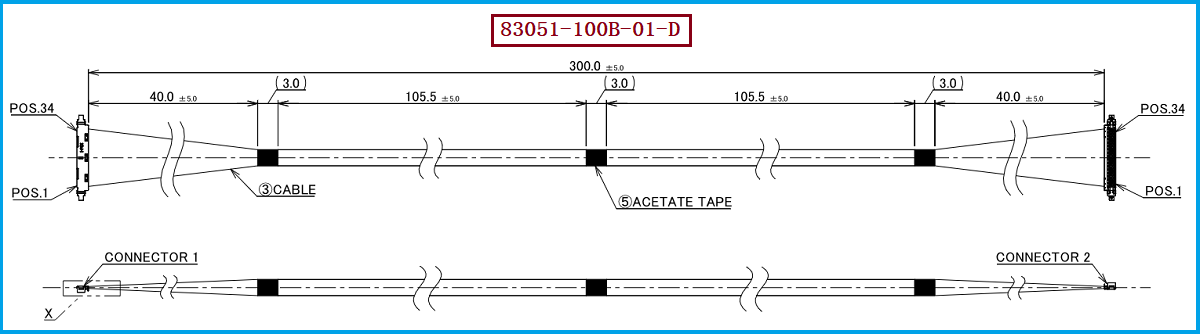
During the selection process for ultra-fine coaxial cable bundles, pursuing an even finer wire diameter may actually increase project risks. Engineers need to consider a comprehensive range of factors including internal equipment space, transmission frequency, characteristic impedance, Pin count, cable length, bend requirements, and connector matching relationships. For example, the design with part number 83051-100B-01-D using 34P, AWG46, 50Ω Micro-Coax, and 300MM length focuses on achieving multi-channel signal connections within limited space by combining extremely fine cables with small connectors. Therefore, when developing alternative products, it is not enough to simply judge the feasibility of substitution based on "changing to a thinner wire with 46AWG"; rather, it is necessary to simultaneously verify impedance consistency, shielding continuity, termination quality, plug-in dimensions, and high-speed signal integrity. For procurement personnel, it is also important to avoid making judgments based solely on wire diameter and unit price, but rather to confirm whether the alternative cable bundle is truly compatible with the original connectors, PCB interfaces, and overall system structure.
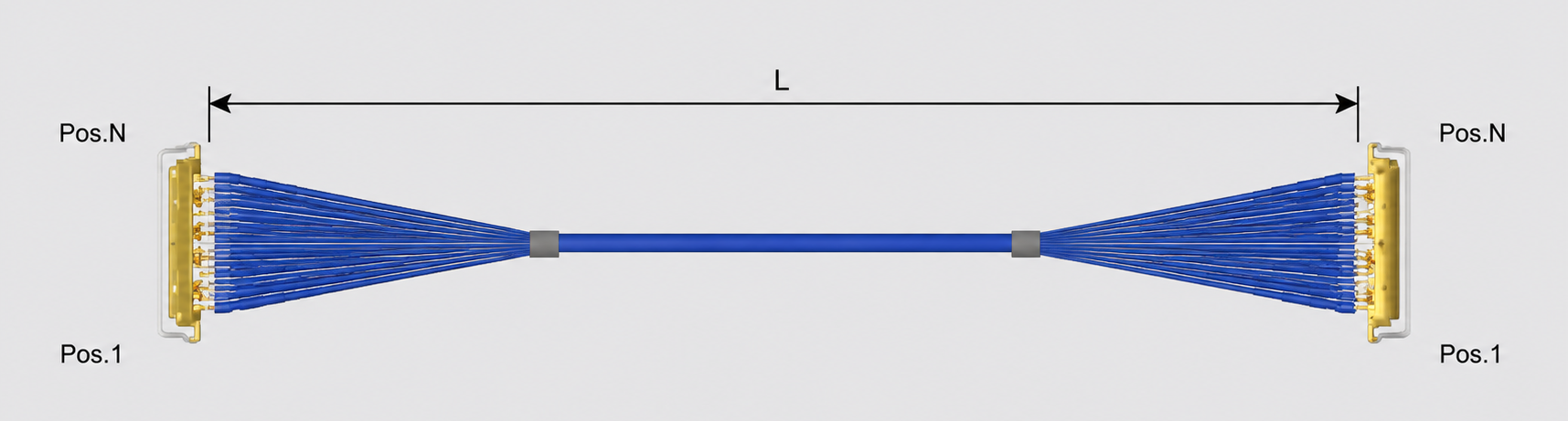
For the domestic compatible alternative development of I-PEX 83051-100B-01-D, it is recommended to match the original product's 34P structure, 20532-034T-02-1 connector, AWG46 Micro-Coax, 50Ω impedance, 300MM length, and 1-1 wiring sequence as basic conditions. At the same time, further verify the cable outer diameter, shielding structure, termination size, fixing position, and bending area. For engineers, they can optimize the wire diameter, impedance, and wire length according to the actual equipment space and high-speed signal requirements. For purchasers, they can reduce the risk of "model consistency but actual incompatibility or unstable performance" during the domestic substitution process by multi-dimensional comparison of original factory part numbers, connector models, wire specifications, and finished product dimensions. Our company can provide: I-PEX 83051-100B-01-D compatible alternative cable assembly solutions, which can be developed around the 20532-034T-02-1 connector, AWG46 ultra-fine coaxial cable, 300MM cable length, and corresponding Pin definition for compatibility, providing customers with ultra-fine coaxial cable assembly alternative support from sample making to mass production.
“Without the consent or authorization of this site, no one shall reproduce, reprint, distribute, cite, change, broadcast or publish the content in whole or in part in any form, nor shall there be any other violation of the copyright of this site.