


Categorization:Harness Component
With the continuous development of laptops, tablets, VR/AR devices, display modules, and other small electronic products towards thinness and high integration, the core contradiction facing high-speed signal connections inside the devices has gradually shifted from "whether it can transmit" to "how to transmit stably in a smaller space." The extremely thin coaxial cable, with its smaller wire diameter, independent coaxial shielding structure, and characteristics suitable for high-density connectors, still has significant application value in the field of high-speed interconnection inside devices. Taking I-PEX CABLINE®-UX II as an example, it adopts a 0.25mm Contact Pitch and a 90° out-line vertical insertion and extraction structure, providing specifications of 30, 34, 40, and 50 pins, and is designed for miniaturization in space-limited and pivot structure applications. The official materials also list 5Gbps/lane NRZ as a reference transmission speed and list reference standards such as USB 3.1 Gen1, V-By-One HS 1.4, HDMI 1.3, eDP, and MIPI. From this perspective, the extremely thin coaxial cable may not "monopolize" the entire high-speed transmission market in the future, but it still has a basis for continuous development in the niche field of high-speed signal interconnection inside small devices.
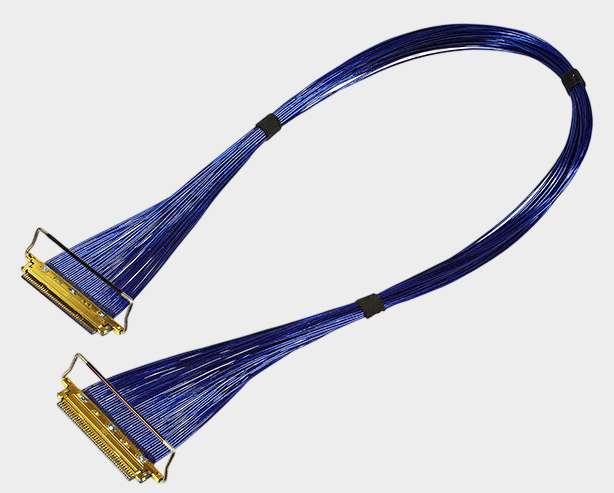
For engineers, the future of high-speed transmission is not only about pursuing higher Gbps, but also about simultaneously addressing issues such as connector size, cable space, EMI, and structural reliability. CABLINE®-UX II uses a 0.25mm narrow pitch, with an insertion height of approximately 1.04 +0.06/-0.1mm and a depth of 2.4mm, allowing the 40Pin version to achieve multi-channel connections in a smaller space; I-PEX also provides a simulation reference case with a 40Pin cable diameter of about 0.24mm, which can pass through a space with an inner diameter of approximately Φ2.66mm. Its multi-point grounding path forms a continuous grounding connection from Wire Shield→Ground Bar→Plug Shell→Receptacle Shell→PCB. For notebook display shafts, slim display devices, and other high-speed connection scenarios with compact internal spaces, the value of this structure will not easily disappear with the development of other high-speed interfaces.
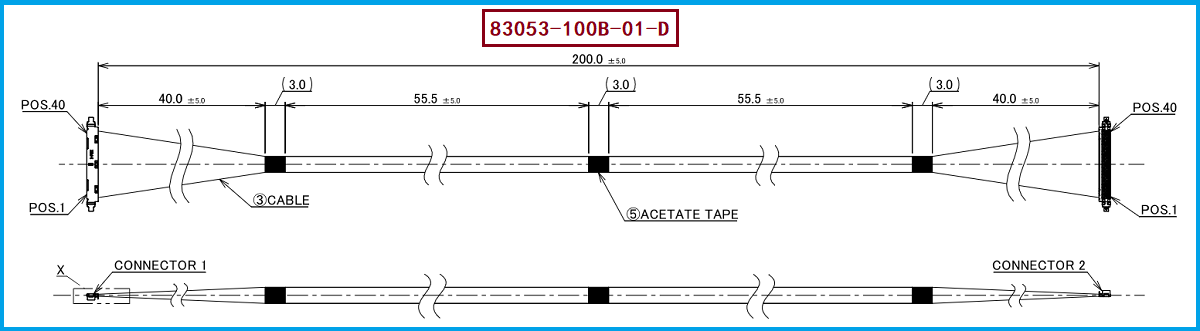
This article corresponds to the product I-PEX 83053-100B-01-D, which belongs to the CABLINE®-UX II 40Pin ultra-thin coaxial cable assembly. The official model specifications correspond to 40Pin, Micro-Coaxial 46AWG, L=200mm, 1-1; the connector model used at the end of this product cable is 20532-040T-02-1, and the wire position is defined as 1-1. In practical engineering applications, purchasers cannot simply judge that the cable assembly can be directly substituted by looking only at "40Pin, 200mm", because there is also an 82658-100B-02-D in the same series with 40Pin, 200mm, 1-N, which has a different wire position definition. I-PEX's current official model list explicitly lists 83053 as a standard Harness of 40Pin, 200mm, 1-1, so when inquiring, sampling, and seeking domestic alternatives, 83053-100B-01-D, 46AWG, 200mm, 1-1, 20532-040T-02-1 should be taken as complete specification identification conditions, rather than simply providing a vague name of "UX II 40Pin cable assembly".
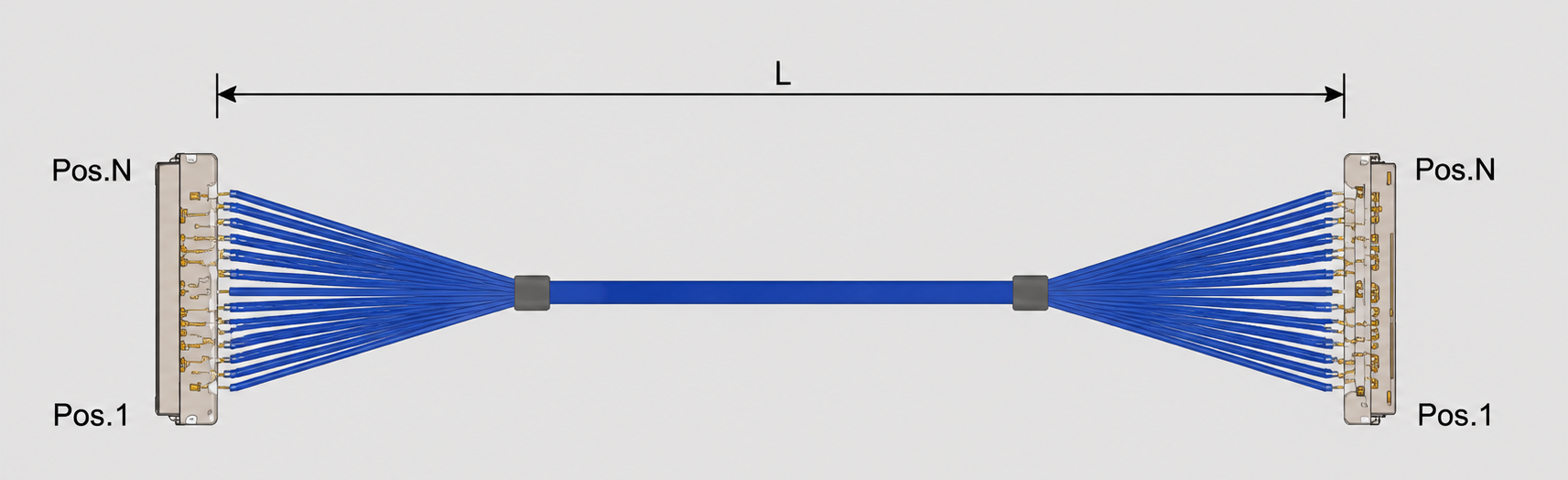
From the perspectives of procurement and engineering substitution, whether the ultra-fine coaxial cable will continue to grow in the future is not just about how much the market transmission rate improves, but whether suppliers can continuously solve smaller space, higher density, more stable signal, and batch manufacturing consistency. For the compatibility substitution of 83053-100B-01-D, it is recommended to first confirm the CABLINE®-UX II connector system, 40Pin, 0.25mm Pitch, 46AWG Micro-Coaxial, 200mm cable length, and 1-1 wire position definition, and then further check the cable outer diameter, impedance, shielding structure, termination method, and actual assembly space; for high-speed applications, it should also be combined with the whole machine for SI/EMI verification, and not just judge "complete compatibility" based on mechanical dimensions. I-PEX also officially states that when the Harness specification changes, the Part Number needs to be correspondingly changed. Our company can provide: 83053-100B-01-D compatible substitute cable harness solution, which can match the specifications, process and manufacture, and develop substitution solutions for ultra-fine coaxial cable harnesses based on the original factory drawings, connector models, and actual usage requirements, providing support for engineering verification and procurement of domestic substitutions.
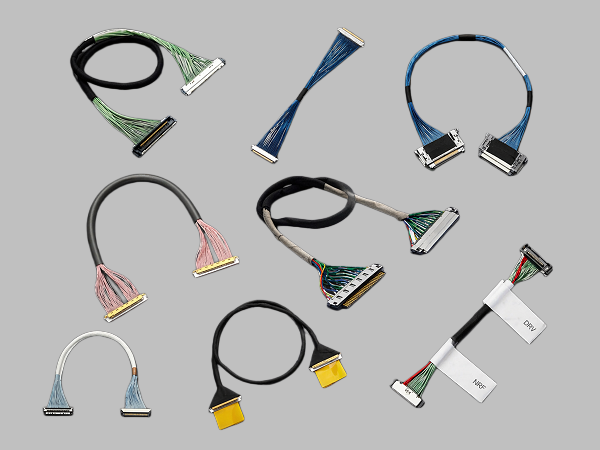
“Without the consent or authorization of this site, no one shall reproduce, reprint, distribute, cite, change, broadcast or publish the content in whole or in part in any form, nor shall there be any other violation of the copyright of this site.