


Categorization:Harness Component
In high-speed electronic devices, the extremely fine coaxial cables are not just for "connecting the signal from point A to point B," but the cables themselves also have an impact on high-speed signals. One of the most important indicators is the transmission loss (Insertion Loss). Simply put, when the signal travels from the sending end through an extremely fine coaxial cable to the receiving end, the energy will be attenuated with the transmission distance, frequency, and cable structure factors, and this attenuation is the transmission loss that engineers need to focus on. For low-speed signals, a small amount of loss may not be significant, but when the system enters the high-speed data transmission state, with the increase of frequency, conductor loss, dielectric loss, and impedance discontinuity factors become more pronounced, so the wire diameter, impedance, length, shielding structure, and connector termination quality of the cable will affect the final signal quality. The I-PEX CABLINE®-SS series is positioned for high-speed extremely fine coaxial connection applications, and the high-speed verification conditions provided by the official specifications include 40Pin, AWG#40 Micro-Coaxial Cable, 45Ω impedance, and 100mm cable length, and supports the high-speed application of up to 16Gbps/Lane.
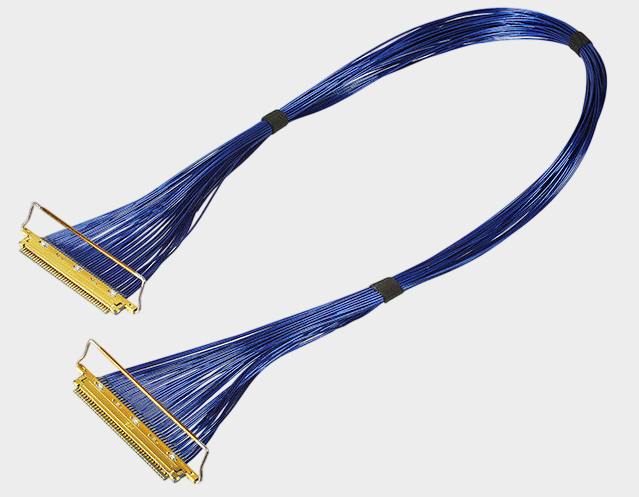
The product introduced this time is I-PEX 83012-100B-01-D, which belongs to the CABLINE®-SS 14Pin ultra-thin coaxial cable assembly. The engineering drawing shows that it uses AWG #40 Micro-Coaxial Cable, 50Ω impedance, 300.0±5.0mm length, and 1-1 straight-through wiring sequence. The cable end connector model is 20373-R14T-06, corresponding to 14PIN, 0.4MM Pitch. For engineers, these parameters need to be understood as a whole: usually, when the cable specifications are consistent, the longer the cable assembly length, the longer the transmission path, and more attention needs to be paid to signal attenuation; AWG40 is a relatively thin high-speed cable, and its electrical characteristics must be matched with the connector end structure and system impedance. In addition, this 83012-100B-01-D uses 50Ω cable impedance, while the official high-speed performance demonstration of CABLINE®-SS uses 45Ω cable for verification, so when actually replacing and developing, different impedance specifications cannot be simply regarded as completely the same. Selection and verification should be based on the actual impedance requirements of the customer's system.
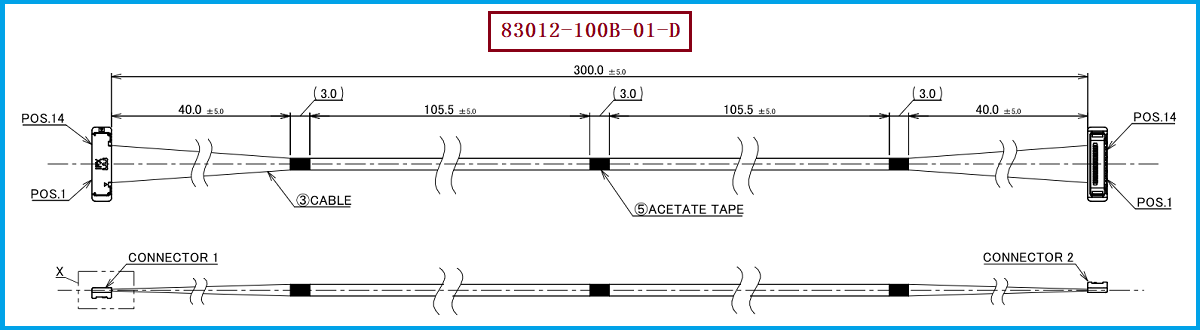
From the perspective of engineering testing, the determination of transmission loss of ultra-fine coaxial cable束 cannot be based solely on the wire material itself; attention also needs to be paid to the entire connection chain. Usually, it is possible to test the S-parameters with a high-speed network analyzer, where S21 is typically used to observe the transmission characteristics of the signal from the input end to the output end, and Insertion Loss at specific frequencies can help engineers judge the degree of attenuation caused by the cable束 on high-speed signals. For actual projects, a comprehensive analysis should be conducted by combining Return Loss, impedance consistency, and loss curves at different frequencies. If the cable length changes, the wire material is changed from AWG40 to another specification, or the connector termination structure changes, it may lead to different high-speed performance from the original design. Therefore, when purchasing agents are looking for alternative suppliers, it is not recommended to judge whether it is fully compatible only based on "same 14Pin, same 0.4mm Pitch, same 300mm length," but should further confirm the wire impedance, wire diameter, termination technology, and actual high-speed test data. For I-PEX 83012-100B-01-D ultra-fine coaxial cable束 with 14Pin and 300mm length, the actual alternative verification should especially pay attention to the length, 50Ω impedance, AWG40 wire material, and overall signal integrity after the connector termination.
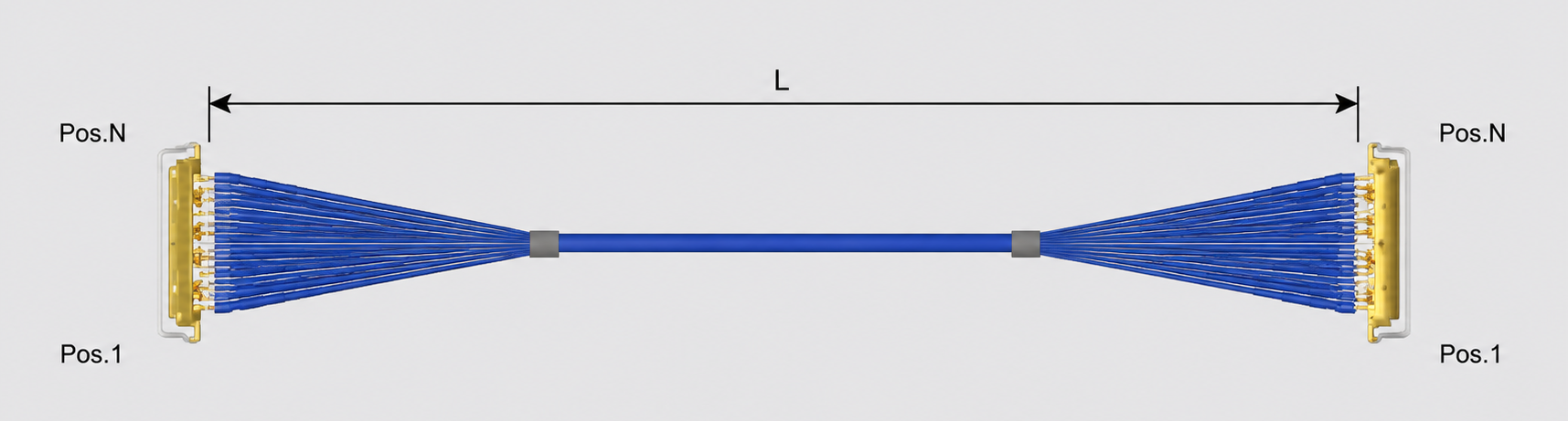
For engineers and procurement personnel, when considering a compatible replacement for the existing device using I-PEX 83012-100B-01-D, it is recommended to first confirm the core parameters such as 14PIN, 0.4MM Pitch, 20373-R14T-06, AWG #40, 50Ω, 300mm, and 1-1 wire sequence. Then, according to the specific high-speed interface and system frequency, verify transmission loss, return loss, and impedance consistency. It is especially important to note that the same connector model does not necessarily mean that the overall high-speed performance of the cable assembly is completely the same. The cable structure, shielding layer, termination process, and manufacturing consistency also affect the final result. Our company can provide: I-PEX 83012-100B-01-D compatible replacement cable assembly solutions, which can be manufactured according to the actual requirements of the customer for 14Pin ultra-fine coaxial cable assembly, and matched and developed around key specifications such as the 20373-R14T-06 cable end connector, 0.4MM Pitch, AWG40 cable, cable length, and 1-1 wire sequence. For high-speed applications, further attention can be paid to impedance and transmission performance verification according to project requirements, providing references for engineering introduction and procurement replacement.
“Without the consent or authorization of this site, no one shall reproduce, reprint, distribute, cite, change, broadcast or publish the content in whole or in part in any form, nor shall there be any other violation of the copyright of this site.