


Categorization:Harness Component
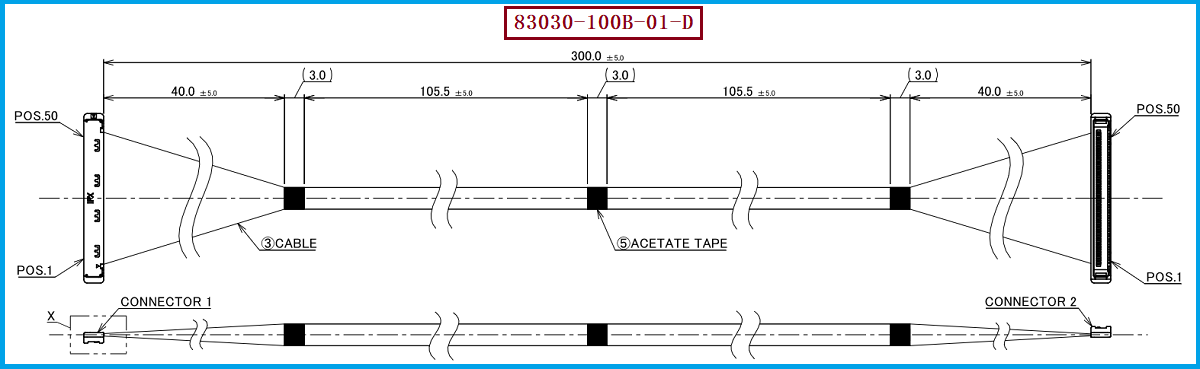
Many engineers and purchasing personnel often have a question when they first encounter ultra-fine coaxial cables: Why is the procurement price of ultra-fine coaxial cables usually higher than that of ordinary cables, even though they are both used for signal transmission? In fact, the manufacturing difficulty of ultra-fine coaxial cables is much higher than that of ordinary conductors. It is not simply making ordinary wire finer; instead, it involves the precise manufacturing of structures such as conductors, insulating layers, shielding layers, and outer sheaths under extremely small outer diameters. It also requires controlling impedance, attenuation, crosstalk, and shielding performance. As applications enter high-speed signal transmission, the dimensional consistency and electrical performance of the cable directly affect the signal integrity of the system. Taking the I-PEX 83030-100B-01-D in this case as an example, it belongs to the CABLINE®-SS 50P 1-1 cable assembly, and the corresponding length of the official model data is 300mm; the specific 83030 engineering drawing specifies the use of 50 AWG #40, 50Ω Micro-Coaxial Cable. This means that what is purchased during procurement is not an ordinary 50-core ribbon cable, but a high-density, high-speed cable assembly composed of 50 ultra-fine coaxial cables.
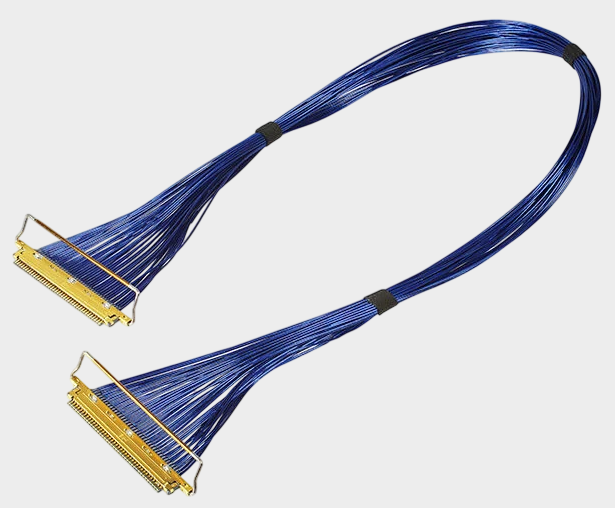
From the perspective of engineers, the cost of extremely thin coaxial cables also comes from the difficulty of backend processing. The finer the wire, the smaller the process window for stripping, cutting, termination, arrangement, fixation, and shielding treatment. When processing 50 wires simultaneously, there is a high requirement for equipment precision, fixture precision, and the production personnel's process control ability. The I-PEX 83030-100B-01-D uses the CABLINE®-SS 50PIN connection scheme, with the connector model for the wire end being 20373-R50T-06, featuring a 50PIN connector with a 0.4MM pitch. According to I-PEX official data, CABLINE®-SS uses a 0.4mm contact pitch and a vertical right-angle structure, supporting 10, 14, 20, 30, 32, 35, 40, and 50Pin, and has a W-Point dual-contact design; the Plug Housing for 50P corresponds to the 20373-R50T-06. For manufacturers, this means that each pin position needs to be accurately terminated and arranged, meeting both mechanical assembly requirements and high-speed signal transmission requirements. Therefore, the value of extremely thin coaxial cable bundles cannot be measured solely by "how much per meter of wire."
For purchasers, the ultra-fine coaxial cable may seem expensive, but what truly needs to be compared is the comprehensive cost of the entire project. If, in order to reduce the unit price, one uses ordinary materials or substitute products with insufficient process capability, once impedance deviation, signal attenuation, increased crosstalk, insufficient shielding effect, abnormal terminal contact, or batch consistency issues occur, subsequent costs such as re-sampling, equipment debugging, quality screening, and even complete machine rework may arise. The official materials of CABLINE®-SS provide high-speed transmission tests under 40P, AWG#40, 45Ω, and 100mm conditions, and list 16Gbps/Lane as its high-speed application capability; at the same time, this series adopts a 0.4mm Pitch and narrow-type structure, which can be used for internal connections of equipment with limited space. Therefore, for engineers, it should be a priority to verify impedance, insertion loss, crosstalk, wire sequence, connector matching, and signal integrity; for purchasers, it should be a comprehensive assessment of material cost, processing yield, quality stability, delivery time, and batch supply capacity, rather than simply using the price of ordinary wires as the comparison benchmark.
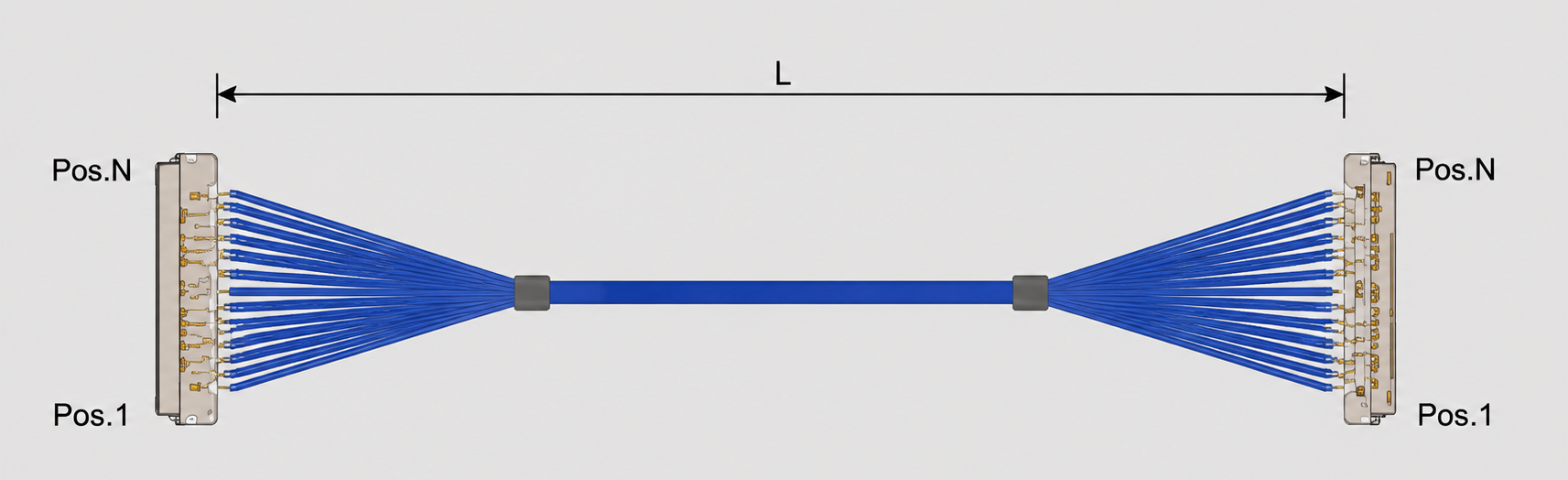
If the original project design uses I-PEX 83030-100B-01-D, it is recommended that the engineering team first confirm the key conditions such as 50PIN, 0.4MM Pitch, 1-1 wire sequence, 300mm length, and AWG#40 Micro-Coaxial Cable. At the same time, confirm the mechanical and electrical matching relationship between the cable end 20373-R50T-06 and the mating connector on the equipment. The official I-PEX CABLINE®-SS product information indicates that the 50P 1-1 cable assembly also includes 100mm of 83028, 200mm of 83029, and 300mm of 83030. Therefore, when selecting alternative options, corresponding products should be selected according to specific length and wire sequence, and not just replaced based on "CABLINE-SS 50P". For projects that require domestication, second suppliers, or cost reduction in procurement, compatible development can be carried out around the connector model, PIN number, Pitch, wire diameter, impedance, length, wire sequence, and assembly dimensions of the original product. Our company can provide: I-PEX 83030-100B-01-D compatible cable assembly solution, which can select ultra-fine coaxial cable materials, cable assembly processing, termination, and sample verification according to customer project requirements, provide compatibility and alternative development support for engineers, and also provide reference for procurement personnel on second supplier and domestic alternative solutions.
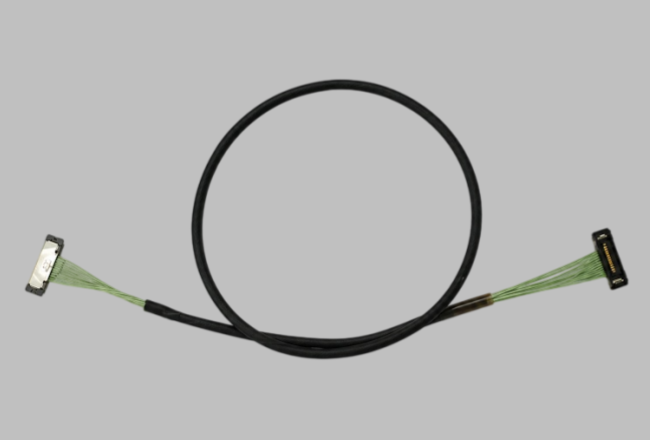
“Without the consent or authorization of this site, no one shall reproduce, reprint, distribute, cite, change, broadcast or publish the content in whole or in part in any form, nor shall there be any other violation of the copyright of this site.