


Categorization:Harness Component
Why is it necessary to perform bend testing on ultra-fine coaxial cable bundles?
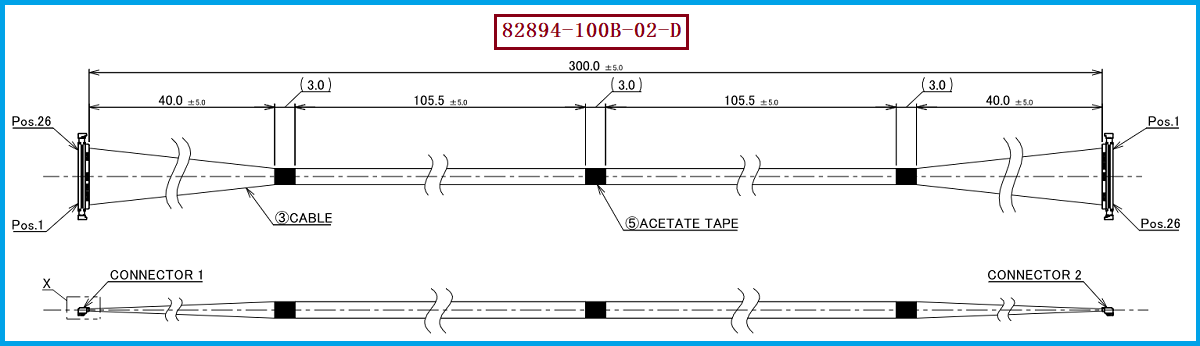
In notebook hinges, camera modules, drones, robots, and other compact electronic devices, extremely thin coaxial cable harnesses often need to pass through narrow spaces and may undergo repeated bending with the device structure. If the internal conductor, insulation layer, or shielding structure of the cable material fatigue after long-term bending, impedance changes, signal attenuation, intermittent open circuit, or even complete failure may occur. Therefore, when engineers evaluate a very thin coaxial cable harness, they cannot only look at the initial conduction and appearance, but also need to verify its mechanical durability through dynamic bending tests. Taking I-PEX 82894-100B-02-D as an example, this product is a CABLINE®-UA II 26P Micro-Coaxial Harness, using 44AWG extremely thin coaxial wire, standard length of 300mm, wire position defined as 1-N, and the Plug Housing model matched with the cable material is 20497-026T-30. I-PEX official materials also show that CABLINE®-UA II uses a 0.3mm Pitch, Vertical Right Angle structure, and 26P is part of its standard pin configuration.
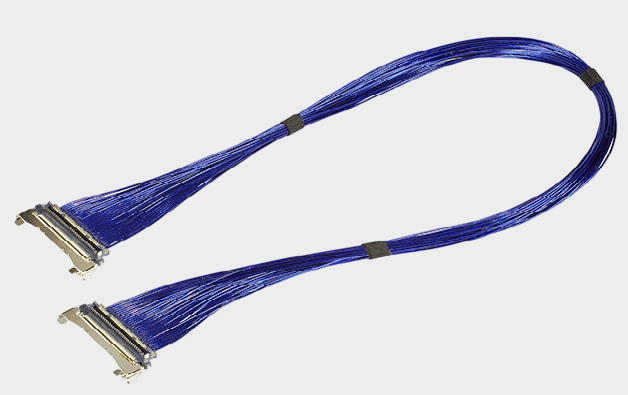
How to conduct a bend testing for extremely thin coaxial cable束?
During actual testing, it is first necessary to determine the bending radius, bending direction, fixation method, reciprocating frequency, and number of tests based on the actual usage status of the product. It is not permissible to simply bend the harness randomly. Typically, it is required to securely fix both ends or a specified area of the harness, allowing the middle effective bending area to move reciprocally along a prescribed trajectory, and to record the conductivity, insulation, and high-speed signal performance before and after the test. For extremely thin coaxial harnesses, it is also necessary to pay close attention to whether there are phenomena such as outer sheath damage, cable deformation, abnormal shielding layer, and loosening of the Bonding at the ends; in terms of electrical aspects, it should be checked whether there are phenomena such as sudden breaks, a decrease in insulation resistance, and a significant deterioration of high-speed signal parameters. For harnesses such as 82894-100B-02-D with 26P, 44AWG, it is even more important not to test only one wire, as in the actual bending process of multi-core extremely thin coaxial harnesses, the stress state of each wire core may be different. The test plan should cover key wire positions and set conditions in conjunction with the actual movement trajectory of the equipment. It should be emphasized that the number of bending times and the bending radius cannot be arbitrarily declared as a unified standard without detaching from the specific product specifications. They should be determined in conjunction with the working conditions of the customer's equipment, the enterprise verification specifications, and applicable reliability test standards.
The test passing is not just about "the wire is not broken," but also about whether the high-speed signal is stable.
The bending performance of extremely thin coaxial cable bundles is actually closely related to high-speed signal integrity. Repeated bending may alter the geometric relationship of the coaxial structure, changing the relative positions of the central conductor, insulation layer, and shielding structure, thereby affecting impedance consistency and high-speed signal transmission. Therefore, engineers can conduct tests on conductivity, insulation, voltage resistance, and high-speed signal performance before and after bending tests, based on project requirements, rather than relying solely on visual judgment. The official documentation for CABLINE®-UA II provides a series of reference transmission speeds of 5Gbps/lane NRZ, listing reference applications such as USB 3.1 Gen1, V-by-One HS 1.4, HDMI 1.3, eDP, and MIPI; these are series reference information and do not mean that 82894-100B-02-D can guarantee the corresponding speed in all systems; actual performance still needs to be verified in combination with cable, length, connector, PCB, and system SI.
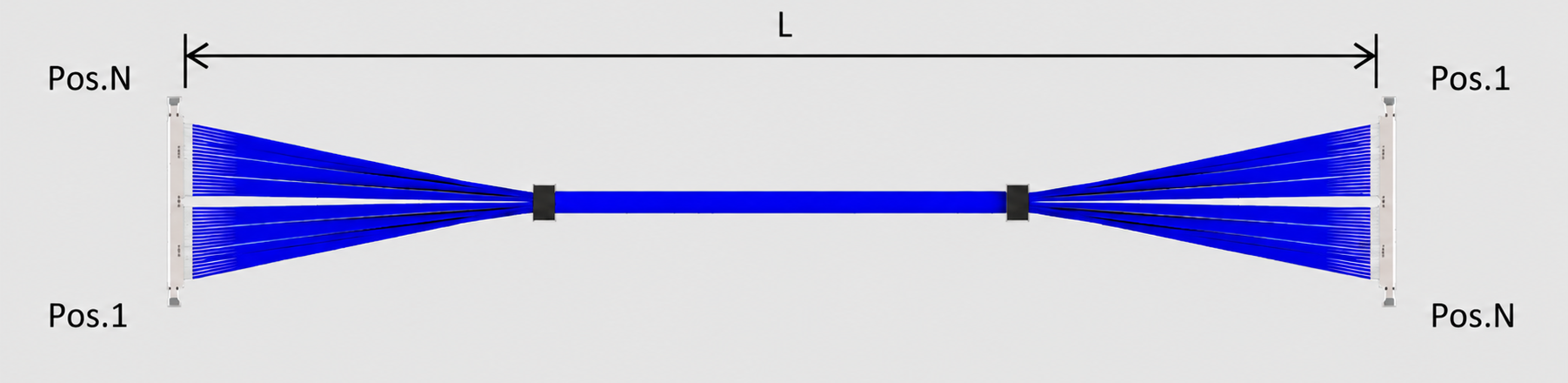
Selection and compatibility with alternative solutions reference and suggestions
For purchasers and engineers, when looking for a replacement harness for 82894-100B-02-D, the bendability should be confirmed along with interface, electrical, and size compatibility. Firstly, key parameters such as 26P, 44AWG Micro-Coax, 300mm, 1-N wire position definition, and 20497-026T-30 Plug Housing should be checked; secondly, it is necessary to confirm whether the terminal structures at both ends, cable outer diameter, impedance, shielding structure, bonding process, and tape fixation method meet the requirements of the original equipment. The official data of I-PEX shows that the CABLINE®-UA II Plug is designed for miniaturization and can be used for structures passing through shafts. In the official examples, the 26P Plug with a cable outer diameter of about 0.29mm can pass through a Φ2.65mm inner diameter space, so the replacement harness not only needs to "fit," but also meet the actual routing space and bending path requirements inside the equipment. Our company can provide: I-PEX 82894-100B-02-D compatible replacement harness solutions, which can be developed for replacement around 26P, 44AWG, 300mm, 1-N wire position definition, and 20497-026T-30 matching structure, and can further verify the bending life, conduction stability, and high-speed signal performance according to the actual application of customers, helping engineering and procurement teams reduce the risk of replacement introduction.
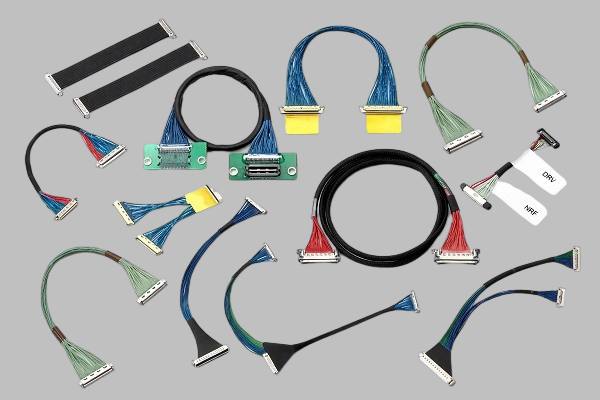
Bend resistance test is an important part in verifying the long-term reliability of extremely thin coaxial cable bundles
For I-PEX 82894-100B-02-D such 26P, 44AWG ultra-fine coaxial cable bundles, a truly reliable bend testing is not simply increasing the number of bends, but establishing a testing method corresponding to the actual equipment working conditions, while also paying attention to mechanical status, electrical continuity, insulation performance, and high-speed signal integrity. Especially in devices with compact spaces and dynamic movements such as pivot axes, camera modules, drones, and robots, the bend life of the cable bundle may directly affect the long-term stable operation of the whole machine. Therefore, when carrying out domestic substitution or supplier introduction, engineers should focus on checking the wire structure, connector termination, wire position definition, and bend testing results, while purchasing personnel should confirm whether the alternative products can form a complete and verifiable reliability program. I am[3W Electronic Components Network]Professional custom production of ultra-fine coaxial cable assemblies and matching connectors, terminals, and board-to-board connectors. If you need technical evaluation or project cooperation, please contact:Manager Zhang 18913228573 (WeChat number the same)For suppliers with the capability to manufacture and test extremely fine coaxial cable bundles, it is only by further progressing from "size compatibility" to "performance and reliability compatibility" that they will have greater practical substitute value.
“Without the consent or authorization of this site, no one shall reproduce, reprint, distribute, cite, change, broadcast or publish the content in whole or in part in any form, nor shall there be any other violation of the copyright of this site.