


Categorization:Harness Component
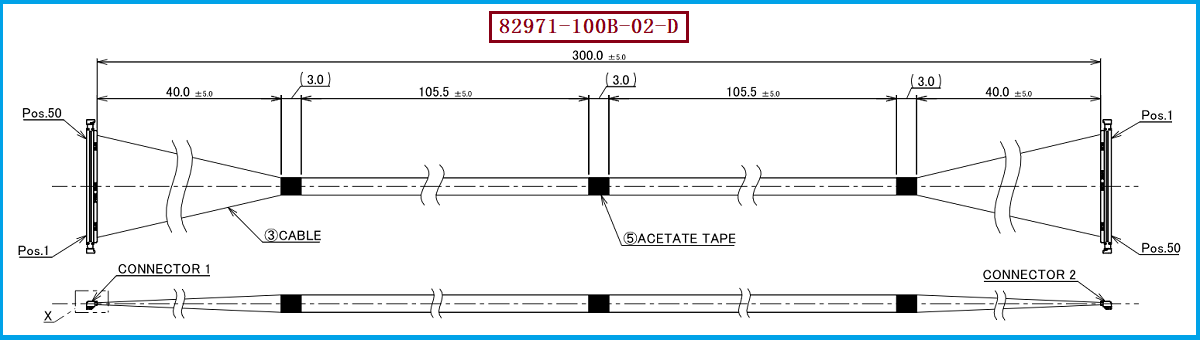
In notebook computers, tablets, display modules, camera modules, and other precision electronic devices, ultra-fine coaxial cable束 primarily undertake the tasks of high-speed signal transmission and high-density internal interconnection, rather than the transmission of large power electrical energy. Taking the product I-PEX 82971-100B-02-D as an example, this product belongs to the CABLINE®-UA II 50P ultra-fine coaxial cable束, with a length of 300MM, and the connector model used at the cable end is 20497-050T-30, corresponding to a 50P high-density connection structure. According to I-PEX official data, CABLINE®-UA II adopts a 0.3mm Pitch, Vertical Right Angle structure, supports 26P, 32P, 40P, and 50P, and is suitable for AWG42, AWG44, AWG46 Micro-Coax. For engineers, the core value of such products lies in miniaturization, lightweight, high density, and high-speed signal connection; for purchasers, when looking for alternative cable束, it should also be first clarified that it belongs to "signal transmission type ultra-fine cable束", and cannot be chosen simply following the思路 of ordinary power cables.
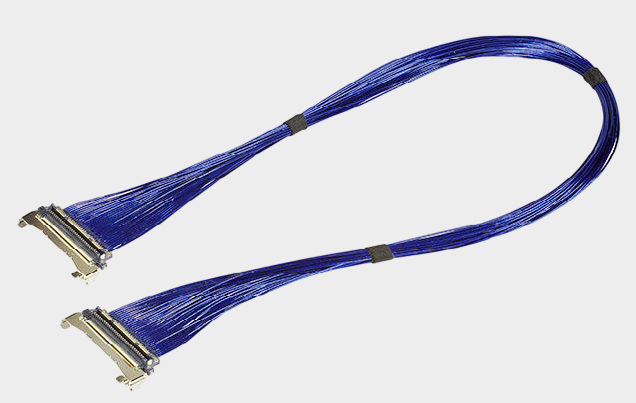
The main reason why extremely fine coaxial cables are not suitable for high-power equipment is that the conductor cross-sectional area is small, allowing a limited amount of current to pass through. The finer the wire, the higher the conductor resistance usually is. When a larger current flows, the conductor generates more heat, and its basic relationship can be understood as P=I²R. If the equipment continuously requires a larger working current, the core may experience significant temperature rise, which further affects the reliability of the insulation layer, shielding layer, connectors, and terminals. Therefore, extremely fine coaxial cables are usually more suitable for transmitting high-speed data signals, while high current power supply should use power cables or conductors with a larger cross-sectional area that match the current, temperature rise, and safety requirements. The I-PEX official CABLINE®-UA II specifications clearly state the rated current for different cables: AWG46 for 0.15A/contact, AWG44 for 0.19A/contact, and AWG42 for 0.20A/contact; although the AWG39 discrete wire can reach 0.5A/contact, the condition is no more than 10 connection points. Therefore, for the 82971-100B-02-D that uses AWG44 Micro-Coax, the design focus is obviously on multi-channel signal connections rather than as a high current, high-power power cable.
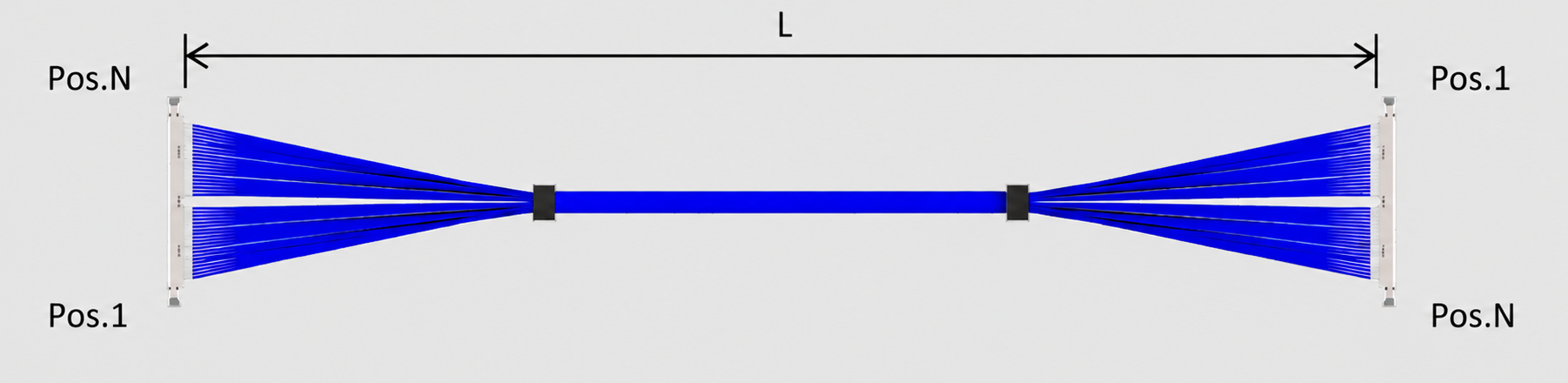
For engineers, the fact that extremely thin coaxial cable assemblies are "not suitable for high power" does not mean that their performance is weaker; rather, it is due to the different design objectives they undertake. Within the extremely thin coaxial cable, the combination of the central conductor, insulating medium, and shielding structure must be completed in a very limited outer diameter while maintaining stable transmission characteristics as much as possible; therefore, the design focus is usually placed on characteristics such as characteristic impedance, insertion loss, return loss, crosstalk, EMI, and signal integrity. According to the official documentation for CABLINE®-UA II, its Micro-Coax has a maximum applicable outer diameter of 0.3mm, with 45Ω applications corresponding to AWG42 or finer specifications, and 50Ω applications corresponding to AWG44 or finer specifications, with 5Gbps/lane NRZ as the reference transmission capability. Additionally, the connector features shielding and multi-point grounding designs, and the official has also showcased an application example where a 26P extremely thin coaxial cable assembly with an outer diameter of approximately 0.29mm passes through a Φ2.65mm shaft or tube bore. Therefore, products like 82971-100B-02-D are more suitable for completing 50 high-density signal interconnections in limited spaces and should not arbitrarily increase their load in pursuit of "high current."
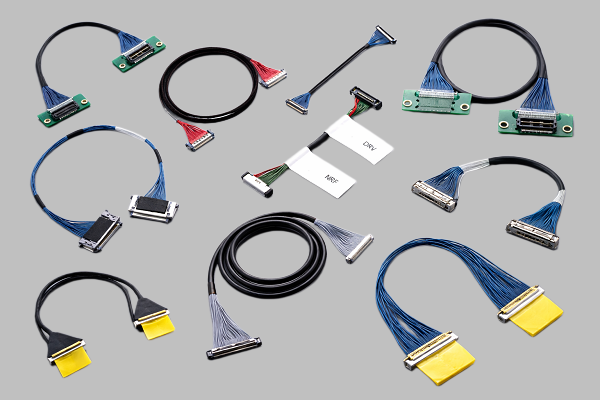
Engineers should first distinguish between the "signal channels" and "power channels" in the equipment when selecting ultra-fine coaxial cable assemblies. If the main task is high-speed display, camera, data, or other high-speed signal transmission, they should focus on checking the number of pins, AWG, impedance, cable outer diameter, cable length, connector model, termination structure, and actual signal rate. If large current supply is required, they should re-select the power cable assembly based on the actual working current, duration, temperature rise, conductor cross-sectional area, and connector rated capacity, and not use ultra-fine coaxial cables directly in high-power circuits solely because they save space. The key identification information for this product is I-PEX 82971-100B-02-D, 50P, 300MM, 20497-050T-30; the I-PEX official page also lists 82971 as the CABLINE®-UA II Harness with 50P, L=300mm. For domestic compatible replacement projects, it is recommended that purchasing personnel provide the original model, cable assembly physical sample, or 2D drawings at the same time, and engineers should check the connectors, pin definitions, cable specifications, impedance, length, and terminal structure. Our company can provide: 82971-100B-02-D compatible replacement cable assembly solutions, which can be prototyped, matched in specifications, and mass manufactured according to the actual structure and technical requirements of the customer's products, providing engineers with a verifiable domestic replacement solution.
“Without the consent or authorization of this site, no one shall reproduce, reprint, distribute, cite, change, broadcast or publish the content in whole or in part in any form, nor shall there be any other violation of the copyright of this site.