


Categorization:Harness Component
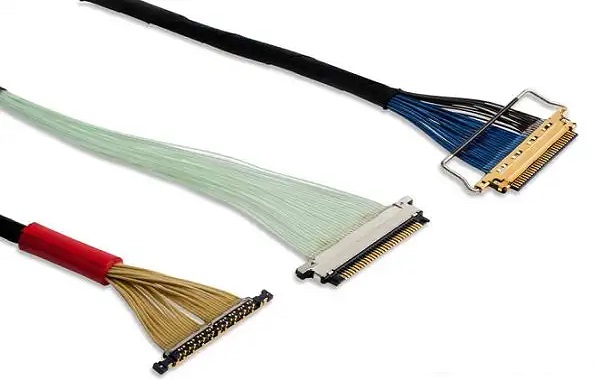
One, comparison of characteristics between eDP and LVDS interfaces
eDP supports high-speed transmission up to several Gbps, suitable for high-resolution, high-refresh rate display devices, while LVDS has a relatively lower data rate, more suitable for medium and low-resolution systems. In terms of pin count, LVDS typically requires more signal lines, while eDP only needs a few pairs of differential lines to achieve multi-channel video and control signal transmission, thus simplifying cable design. Both in terms of power consumption and anti-interference performance, they both have advantages, but eDP performs better in high-performance applications. The high integration and multi-channel capabilities of eDP also conform to the trend of thin and light, high-quality displays, while LVDS remains stable in applications such as industrial, medical, and automotive displays.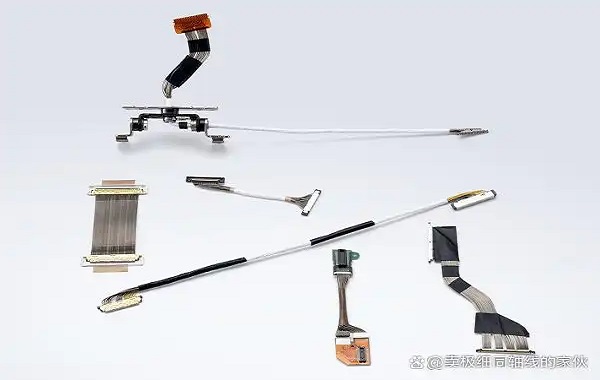
Section 2: Design Differences of Micro Coax Cables
In micro coaxial cable design, LVDS and eDP require the selection of cable materials and wiring methods based on interface characteristics. LVDS commonly uses micro coax with each signal line individually shielded to ensure impedance matching and anti-interference capability. eDP, due to fewer pairs of wires, has a more compact design and is suitable for thin and light devices. Differential impedance matching is the key to ensuring signal integrity, and both LVDS and eDP can use a pair of coaxial cables to form a differential pair to meet the 100 Ω differential impedance requirement. The small size and flexibility of micro coax make wiring both compact and reliable in limited spaces.
Three, application scenario selection
eDP interface is suitable for notebook, tablet, VR/AR and other high-resolution, high refresh rate, thin and light design devices, and can meet future expansion needs. LVDS interface still has advantages in fields sensitive to reliability and cost such as industrial control, medical equipment, and vehicle displays. By reasonably selecting interfaces and micro coax cable design schemes, efficient, stable, and accurate display transmission can be achieved in different application scenarios.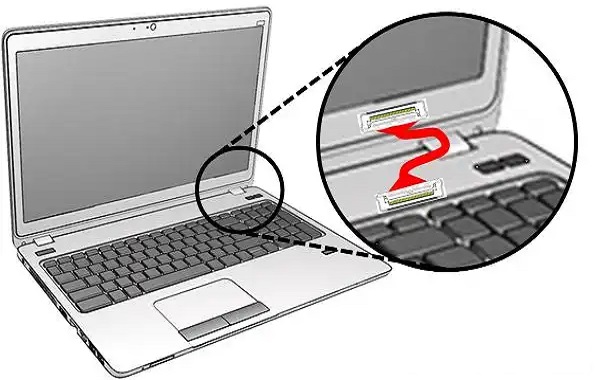
“Without the consent or authorization of this site, no one shall reproduce, reprint, distribute, cite, change, broadcast or publish the content in whole or in part in any form, nor shall there be any other violation of the copyright of this site.