


Categorization:Harness Component
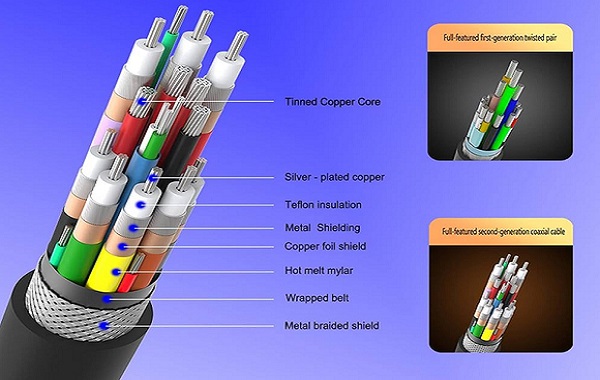
Structure and inherent advantages of ultra-fine coaxial beam
The ultra-fine coaxial cable bundle consists of a central conductor, insulating medium, shielding layer, and outer sheath, forming a complete coaxial structure that ensures a highly independent signal path and excellent electromagnetic constraint ability. For interfaces like USB4 that operate at GHz levels, EMI control and signal integrity are crucial, and the coaxial design of micro coax can achieve low crosstalk, high shielding, and high consistency transmission in a compact space. Therefore, it is widely used in high-speed links of notebook motherboards, AI servers, camera modules, and various portable devices.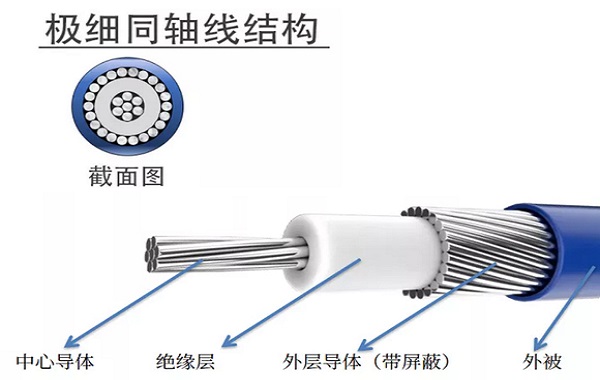
Core technology capability supporting 40Gbps
The ultra-fine coaxial cable束 can meet the high-speed transmission requirements of USB4 mainly due to four key performance features: precise impedance control ensures that high-speed signals do not produce excessive reflections; low insertion loss is attributed to the use of high-purity conductors and low dielectric constant materials, which maintain clear high-frequency signals; strong shielding structure reduces external noise and cross-talk between the wires; and miniaturization and flexible design allow it to achieve bending, wiring, and long-term reliable use at a wire diameter of 0.3–0.5mm. These capabilities collectively ensure the eye diagram quality and transmission stability of USB4 during high-speed operation.
Key Challenges and Countermeasures in Engineering Practice
In actual development, it is not an easy task to ensure that the harness can stably operate at 40Gbps. Long transmission paths can lead to high-frequency attenuation, so it is necessary to shorten the link as much as possible and match it with equalization circuits; impedance discontinuities may cause reflections, which need to be optimized through TDR testing to ensure structural consistency; connectors need to adopt models specifically designed for high-speed protocols such as I-PEX, JAE, etc.; and improve mechanical reliability by controlling the bending radius and reinforcing the shielding layer material. Only through comprehensive coordination from design to manufacturing can micro coax fully release its high-speed transmission performance.
“Without the consent or authorization of this site, no one shall reproduce, reprint, distribute, cite, change, broadcast or publish the content in whole or in part in any form, nor shall there be any other violation of the copyright of this site.