


Categorization:Harness Component
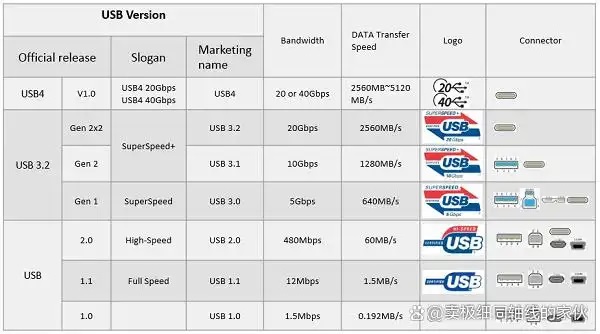
Typical interference in USB3.1 signal
In high-speed signal transmission, USB3.1 faces various interference challenges, including electromagnetic interference (EMI), crosstalk, ground bounce noise, and signal reflections caused by impedance mismatch. High-speed switching signals generate strong electromagnetic radiation, which can easily interfere with adjacent lines and increase the error rate if not effectively shielded. Multi-route parallel wiring or asymmetric wiring can lead to crosstalk, and sharing the ground line may cause ground bounce noise. In addition, discontinuous impedance design or unoptimized solder points and connector transitions can cause signal reflections and eye diagram closure. All these factors threaten the stability and reliability of high-speed data transmission.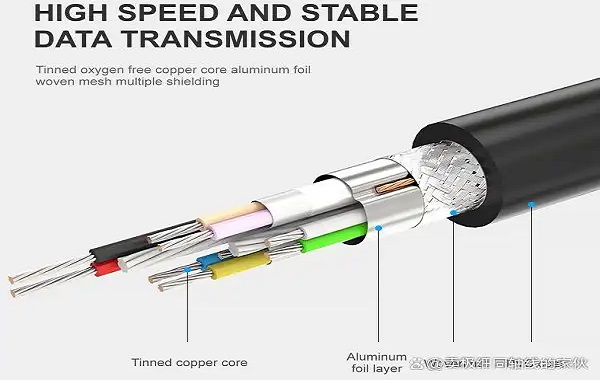
Advantages of solving ultra-fine coaxial beam
Extremely thin coaxial cable bundles, passing through independent shielding structures, effectively suppress EMI and crosstalk. Each signal line maintains strict impedance consistency (usually 90Ω±10%), significantly reducing signal reflection. Its thin and flexible design, with a wire diameter of about 0.3mm, allows for flexible wiring in space-limited environments. At the same time, it uses low dielectric constant insulating materials and silver-plated copper conductors to reduce high-frequency losses, maintaining stable eye diagram opening for 10Gbps signals. These characteristics enable it to ensure signal integrity and system stability in USB3.1 high-speed transmission scenarios, and is a key solution for high-performance electronic devices to achieve both high speed and lightweight.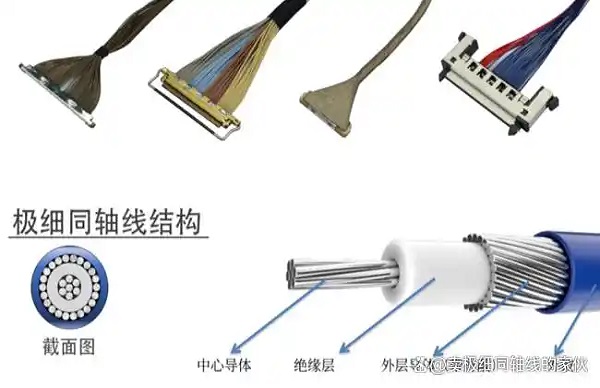
Three, suggestions for interference protection in practical applications
In practical applications, differential noise can be reduced by increasing common-mode chokes at the interface ends, optimizing PCB via and connector matching to reduce impedance突变, and reasonably routing to maintain signal lines of equal length and symmetry. At the same time, high-quality extremely thin coaxial cables should be selected to ensure high-speed communication stability in complex electromagnetic environments. Combined with reasonable design and high-quality cables, the USB3.1 interface system can maintain reliable operation in high-speed and high-density applications and meet the dual needs of future devices for high-speed data transmission and system lightweighting.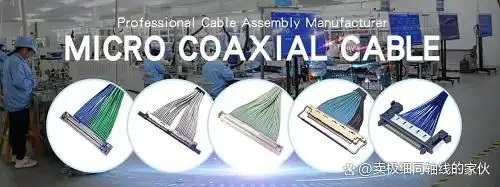
“Without the consent or authorization of this site, no one shall reproduce, reprint, distribute, cite, change, broadcast or publish the content in whole or in part in any form, nor shall there be any other violation of the copyright of this site.