


Categorization:Harness Component
In high-speed camera, AR/VR, display modules, industrial vision, and AI vision equipment, engineers often encounter a problem: why, for the same high-speed signal transmission, some cables can work stably, while others experience signal attenuation, eye diagram degradation, and even communication anomalies as the length increases? This involves the transmission loss of extremely thin coaxial cables. Simply put, transmission loss refers to the attenuation of signal energy as high-speed electrical signals propagate through the cable, with the increase in frequency and transmission distance. Extremely thin coaxial cables are not as simple as "the thinner the wire, the greater the loss"; their actual performance also depends on factors such as conductor size, insulating material, shielding structure, characteristic impedance, connector termination quality, cable length, and working frequency. The extremely thin coaxial cable product number/model introduced this time is I-PEX 82189-100B-02-D, which belongs to the CABLINE®-VS 30Pin Harness, using 30 AWG#40, 50Ω Micro-Coaxial Cables, with a length of 100mm, Pin Assignment of 1-N, and the connector model used at the cable end is 20454-230T. For engineers, these parameters are actually closely related to high-speed signal loss and the ultimate signal integrity.
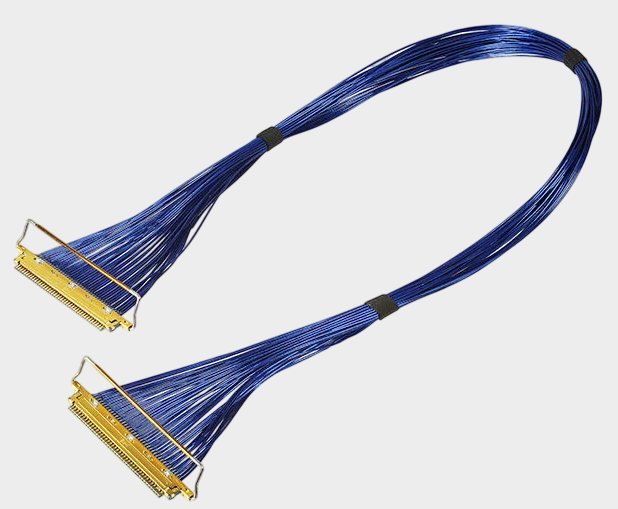
The transmission loss of extremely fine coaxial cables can usually be understood from aspects such as conductor loss, dielectric loss, and additional losses from connectors and terminations. As the transmission frequency increases, the skin effect in the conductor becomes more pronounced, with high-frequency currents tending to flow on the surface of the conductor, thereby increasing the effective resistance; at the same time, the insulating medium will also generate dielectric loss under high-frequency conditions. When the cable length increases, these losses accumulate further, resulting in phenomena such as amplitude decrease, slower rise edges, and reduced signal margin at the receiving end. For the I-PEX 82189-100B-02-D, its standard length is 100mm, and it uses AWG#40, 50Ω Micro-Coaxial Cable. Such specifications reflect the design concept of balancing high-density wiring and high-speed signal transmission in limited spaces. I-PEX official data shows that CABLINE®-VS is aimed at high-speed transmission applications with up to 32 Gbps/lane, supporting AWG36, AWG38, AWG40, AWG42, and AWG44 Micro-Coaxial Cables, and providing 20, 30, 40, and 50Pin specifications. Therefore, in actual projects, one cannot simply look at whether "the cable can pass through," but also needs to evaluate the actual Insertion Loss, Return Loss, and overall Signal Integrity of the link according to the target rate, operating frequency, and cable length.
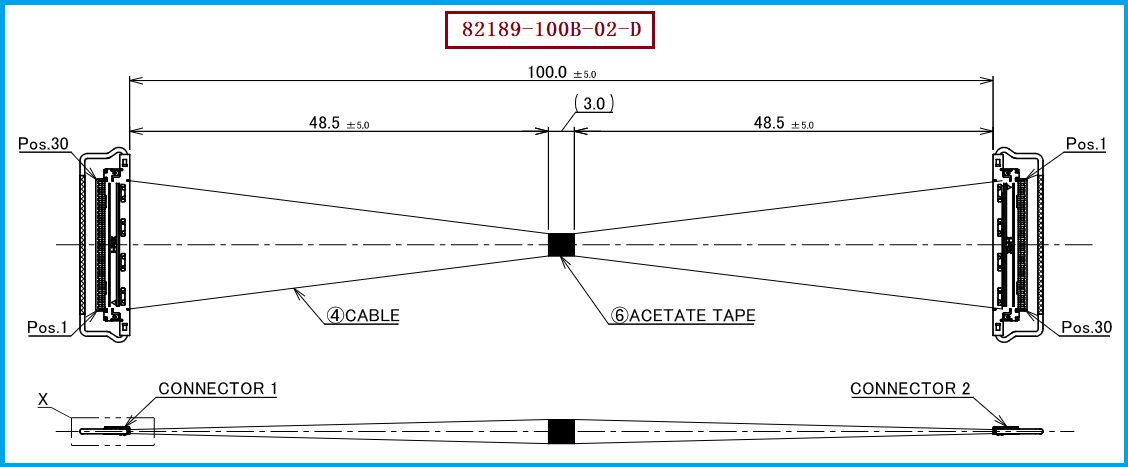
Engineers must first confirm that the characteristic impedance of the wire material matches the system when selecting components, followed by attention to wire harness length, AWG specification, connector structure, termination process, and high-speed signal test data. Poor impedance continuity can cause signal reflections even if the wire material itself has low loss, as impedance discontinuities at the connector end, welding end, or wire transition area may occur; for purchasers, it is also not enough to judge whether a product can be substituted based solely on static parameters such as "AWG#40" or "30Pin." Instead, further confirmation of product part number, connector model, wire sequence, length, impedance, and high-speed performance verification conditions is required. This product uses the wire end connector model 20454-230T, which is listed as CABLINE®-VS 30Pin Plug Housing in the official I-PEX documentation. The official 30Pin evaluation cable clearly lists 82189-100B-02-D: Micro-Coaxial 40AWG, L=100mm, 1-N. This also indicates that the substitution of high-speed cables cannot be simply understood as "connectors are the same and wire diameter is the same." A truly reliable substitution solution needs to ensure consistency in mechanical dimensions, wire sequence, termination process, and high-speed transmission performance.
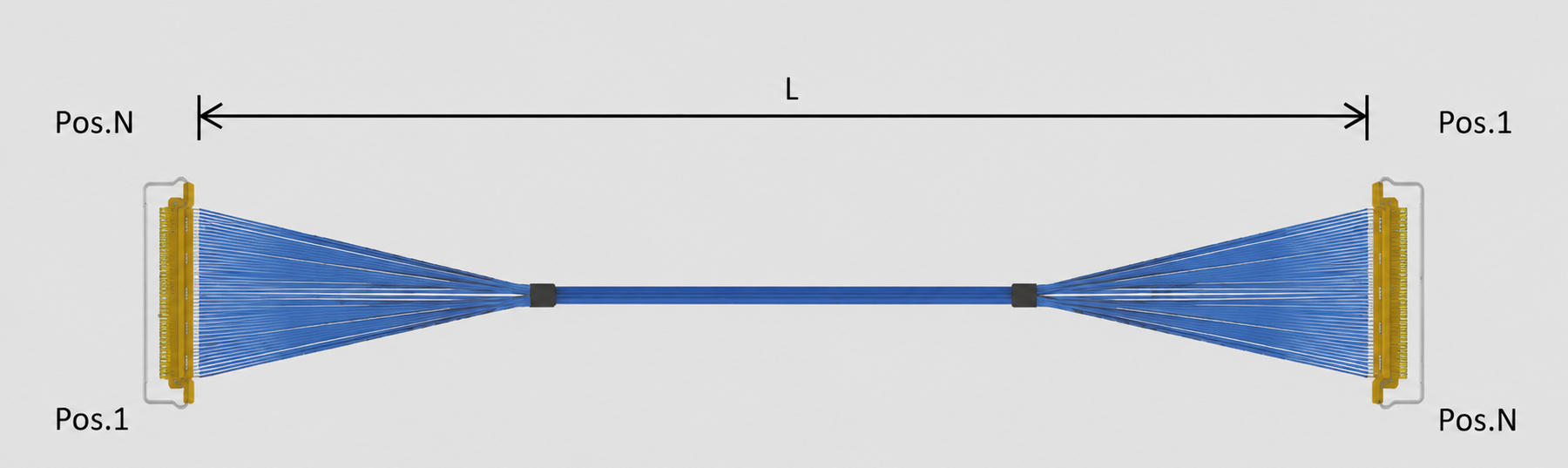
For customers needing to replace the I-PEX 82189-100B-02-D, it is recommended to use the original product as the specification benchmark and to confirm each item sequentially from connectors, cables, length, pin count, wire sequence, and high-speed performance. This model is 30Pin, AWG#40, 50Ω, 100mm, 1-N structure, with the cable end connector being 20454-230T; the I-PEX official CABLINE®-VS data shows that this series uses a 0.5mm Contact Pitch, Horizontal Mating, 1.0±0.1mm Mated Height, and supports AWG40 Micro-Coaxial Cable. In the actual domestic substitution process, if only the cable is replaced without controlling the connector termination, impedance continuity, and wire sequence, it may result in the original equipment working normally while the substituted cable assembly showing insufficient high-speed signal margin. Our company can provide: I-PEX 82189-100B-02-D compatible cable assembly substitution solutions, which can be developed for compatibility substitution based on customer equipment structure and high-speed signal requirements, focusing on core specifications such as the 20454-230T connector, AWG#40 ultra-thin coaxial cable, 30Pin, 50Ω, 100mm, and 1-N wire sequence, and can further match line length, cable exit direction, and end structure for actual applications. For the engineering verification stage, it is recommended to prioritize TDR impedance testing, Insertion Loss, Return Loss, and high-speed eye diagram verification, rather than just conducting low-speed conduction tests.
“Without the consent or authorization of this site, no one shall reproduce, reprint, distribute, cite, change, broadcast or publish the content in whole or in part in any form, nor shall there be any other violation of the copyright of this site.