


Categorization:Harness Component
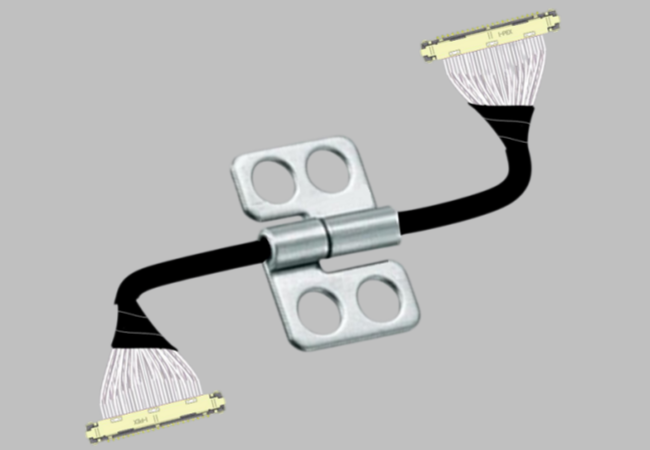
From the perspective of engineering design, ultra-thin coaxial cables cannot be simply understood as "completely replacing FPC." A more accurate statement is that in scenarios with high-speed signals, narrow spaces, bending wiring, and connections with high EMI requirements, ultra-thin coaxial cables can become an alternative solution to traditional FPCs. FPCs have characteristics such as overall thinness, high integration of lines, and suitability for various circuit layouts. Ultra-thin coaxial cables adopt an independent coaxial structure, with each line having its own signal conductor, insulating layer, and shielding structure, which has its own advantages in high-speed signal transmission and shielding design. The I-PEX CABLINE®-UX II uses a 0.25mm contact pitch and a vertical wiring structure, supporting 30/34/40/50PIN, and is aimed at internal connections within thin and space-limited devices. Therefore, in positions such as laptop hinges, display modules, and small high-speed electronic devices, it is more suitable to compare solutions based on specific structures rather than simply judging which type of cable material is "absolutely better."
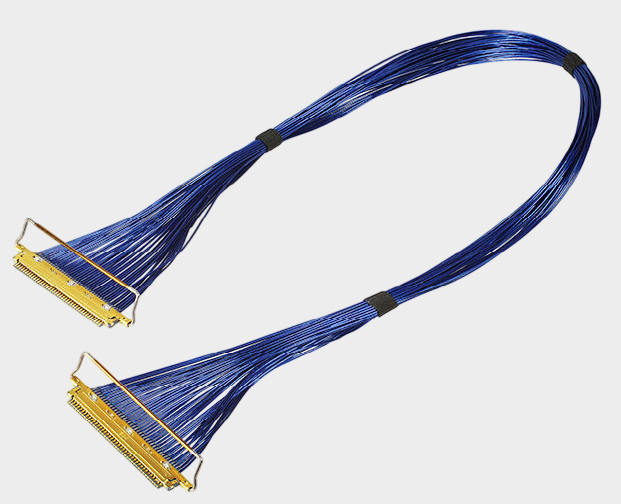
For engineers, ultra-thin coaxial cables often have high application value if products have high-speed display or data transmission internally while also needing to pass through pivot points, narrow gaps, or complex bending paths. CABLINE®-UX II supports Micro-Coaxial Cable and provides a high-density connection solution with a 0.25mm pitch; the reference transmission capability listed in the official materials is 5Gbps/lane NRZ, and it also lists application references for USB 3.1 Gen1, V-By-One HS 1.4, HDMI 1.3, eDP, and MIPI, etc. Its shielding path is Cable Shield → Ground Bar → Plug Shell → Receptacle Shell → PCB, which is conducive to constructing a continuous shielding grounding path. Therefore, when traditional FPC is difficult to meet design requirements in terms of high-speed signals, dynamic bending, or local space layout, ultra-thin coaxial cables can be used as an alternative solution for simulation, prototyping, and signal integrity verification.
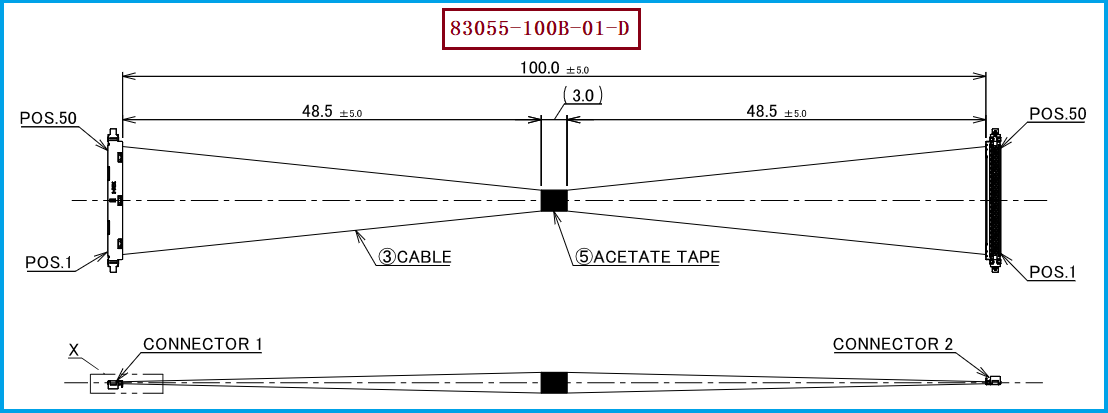
This product corresponds to the model I-PEX 83055-100B-01-D. According to the engineering drawings, the product belongs to the CABLINE®-UX II 50P HARNESS, using Micro-Coaxial Cable AWG #46, 50Ω, Blue, with a harness length of 100.0 +5.0/-0 mm, and both ends using a 1-1 corresponding 50PIN wiring sequence. The wire harness uses a connector model of 20532-050T-02-1, with a 50PIN connector and a 0.25mm pitch. For engineers, this 50PIN high-density connection method can achieve multi-channel signal connections within a limited PCB area; for purchasers, it means that when replacing, it is not only necessary to check if it can be connected, but also to verify key parameters such as 50PIN, 0.25mm pitch, 46AWG, 50Ω, 100mm length, 1-1 wiring sequence, and terminal structure, to ensure that the replacement product meets the assembly and electrical requirements of the original design.
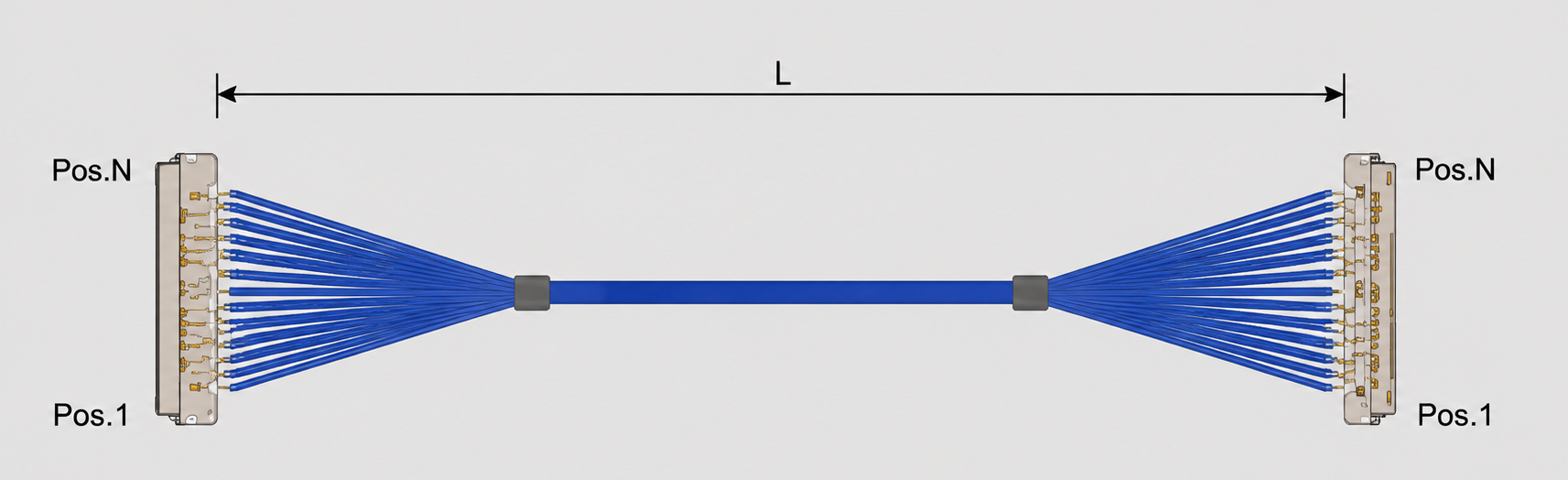
If the project is currently using traditional FPC but encounters limitations in high-speed signal, spatial layout, dynamic bending, or EMI design, the ultra-thin coaxial cable bundle can be included in the alternative evaluation. When selecting, engineers are advised to first confirm the internal space of the device, signal speed, cable bending path, connector installation method, and shielding grounding requirements; purchasing personnel should focus on verifying the channel count, length, connector, termination relationship, and supplier specifications of the original FPC or original cable bundle, rather than simply finding substitutes based on appearance. For I-PEX 83055-100B-01-D, it is recommended to pay close attention to parameters such as 20532-050T-02-1, 50PIN, 0.25mm Pitch, AWG #46, 50Ω, 100mm, and 1-1 wire sequence. Our company can provide: 83055-100B-01-D compatible alternative cable bundle solutions, which can be developed for the structure and specifications of ultra-thin coaxial cable bundles based on the customer's original cable bundle, product drawings, or samples, and provide support for engineering verification, domestic substitution, and bulk procurement.
“Without the consent or authorization of this site, no one shall reproduce, reprint, distribute, cite, change, broadcast or publish the content in whole or in part in any form, nor shall there be any other violation of the copyright of this site.