


Categorization:Harness Component
With the increasing data transmission rates of laptops, tablets, AI devices, industrial vision, and high-speed display equipment, engineers often pay attention to a question when making internal high-speed signal connections: **How is the compatibility of ultra-thin coaxial cables with high-speed protocols such as USB4?** From a technical perspective, protocols such as USB4, USB 3.x, eDP, HDMI, etc., do not directly determine which type of cable must be used. What truly affects the high-speed transmission effect is the entire high-speed interconnect chain consisting of the cable and connector, including impedance control, insertion loss, return loss, crosstalk, shielding, length, and the SI performance of the connector. Therefore, ultra-thin coaxial cables can be applied to high-speed protocols, but they need to be verified according to specific data rates and link design. The I-PEX official CABLINE®-UX II documentation provides a reference transmission speed of 5Gbps/lane NRZ, and lists USB 3.1 Gen1, V-By-One HS 1.4, HDMI 1.3, eDP, and MIPI as reference applications. The page also provides Single/Differential SI test materials. For applications with higher data rates such as USB4, compatibility cannot be judged solely by the name "ultra-thin coaxial cable" or "CABLINE®-UX II", but should be evaluated by combining the specific cable structure, connector, length, and system SI test results.
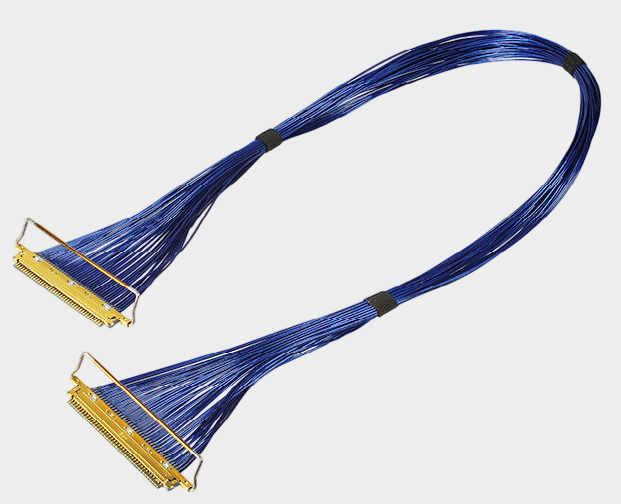
For example, I-PEX 83056-100B-01-D is a very thin coaxial cable assembly with CABLINE®-UX II 50Pin, 200mm, 1-1 structure. The official product page of I-PEX clearly lists this model as 50Pin Micro-Coaxial 46AWG, L=200mm, 1-1. The advantage of this type of cable assembly is not simply pursuing "the thinner the better", but rather achieving high-density signal connections through multiple independent Micro-Coax channels in limited space. CABLINE®-UX II uses a 0.25mm Contact Pitch and Vertical Right Angle structure, with a height of about 1.04mm, supporting 30/34/40/50Pin; the official also showcased an application example of a 40Pin cable assembly using a coaxial cable with an outer diameter of about 0.24mm and a Φ2.66mm pivot hole. Therefore, for devices that need to arrange multiple high-speed signals in a narrow space, extremely thin coaxial cable assemblies can take into account channel density, flexibility, and space utilization. However, for high-speed protocols such as USB4, whether they can work stably ultimately still needs to be based on the specific link's SI verification results, and cannot be simply judged based on the Pin count.
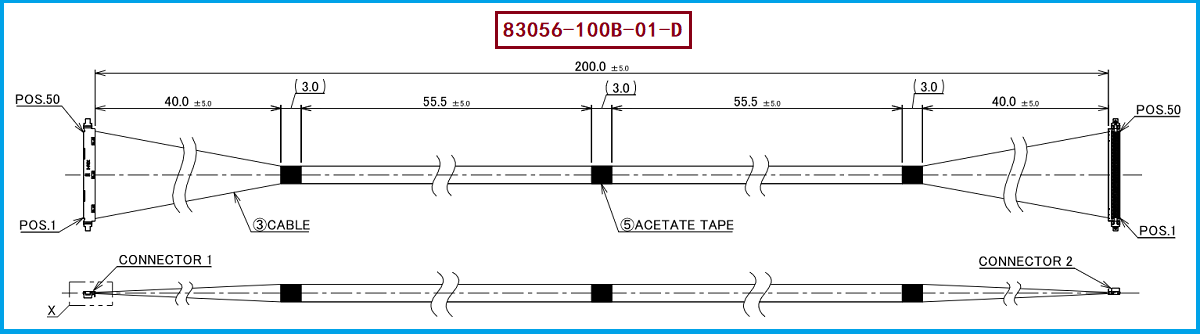
From the perspective of engineering replacement and procurement, I-PEX 83056-100B-01-D corresponds to a CABLINE®-UX II cable assembly with 50 pins, 200mm, and a 1-1 configuration; the wire material in the original I-PEX drawings is AWG#46, 50Ω Micro-Coaxial Cable; the BOM uses two 20532-050T-02-1 Housing Assemblies, accompanied by 50 Micro-Coaxial Cables. The official I-PEX product page also lists 20532-050T-02-1 as a recommended material number for 50Pin Plug Housing. According to customer project requirements, our company can process compatible replacement cable assemblies around this connector and adapt AWG#40 ultra-thin coaxial cable. It is necessary to differentiate here: AWG#40 is the wire material specification used in our replacement solution, not the AWG specification in the original I-PEX 83056-100B-01-D drawings. After using AWG#40, the wire diameter, impedance, outer diameter, flexibility, termination processing, and high-speed signal performance all need to be reconfirmed in combination with the actual wire material model, especially for high-speed applications such as USB4. It is more recommended to conduct TDR, insertion loss, return loss, and crosstalk SI project verification at the sample stage. Our company can provide: I-PEX 83056-100B-01-D compatible replacement cable assembly solutions, which can be developed for connector, wire material, length, wire sequence, and processing structure matching according to project requirements.
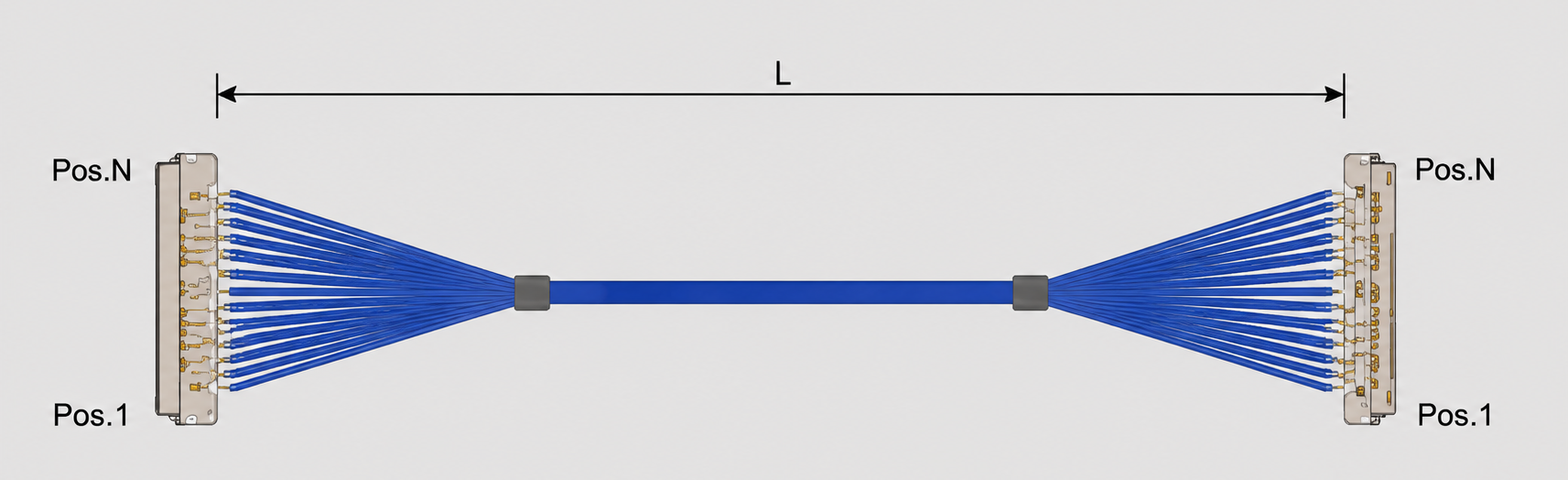
For engineers, when selecting a compatible alternative solution for the 83056-100B-01-D, the first step should be to confirm whether the device end corresponds to the CABLINE®-UX II 50Pin interface and whether the 20532-050T-02-1 meets the actual assembly requirements. Subsequently, confirm the cable length, 1-1 wire sequence, AWG specification, impedance, wire diameter, and bending space. If the application involves USB4 or other high-bandwidth protocols, it is recommended not to compare only the AWG but to consider the connector, cable, and PCB as a complete high-speed channel for evaluation, with a focus on insertion loss, return loss, impedance continuity, near-end/far-end crosstalk, and shielding ground continuity. The official structure of CABLINE®-UX II has a grounding path design of Cable Shield → Ground Bar → Plug Shell → Receptacle Shell → PCB, which helps to build a continuous shielding path. For purchasers, it is further necessary to confirm whether the alternative product can be supplied stably, whether it supports sample verification and mass production, and whether the AWG#40 alternative solution meets the customer's mechanical, electrical, and high-speed signal requirements. Only after completing sample testing and system verification can "connector compatibility" be further transformed into "the entire high-speed link is replaceable."
“Without the consent or authorization of this site, no one shall reproduce, reprint, distribute, cite, change, broadcast or publish the content in whole or in part in any form, nor shall there be any other violation of the copyright of this site.