


Categorization:Harness Component
For high-speed electronic equipment, a very fine coaxial cable is not just a simple thinner version of a regular wire. Instead, it forms specific electrical properties through the size relationships between the central conductor, insulating layer, shielding layer, and external structure. Taking I-PEX 81467-100B-02-D as an example, this product belongs to the CABLINE®-UA II 40Pin very fine coaxial cable assembly, using 40 AWG#44, 50Ω Micro-Coaxial Cables, with a nominal cable length of 200mm and a 1-N structure. The connector model at the cable end is 20497-040T-30. According to I-PEX official data, the CABLINE®-UA II connector supports AWG42, AWG44, and AWG46 Micro-Coax, and is aimed at high-speed signal transmission and miniaturized wiring applications. For engineers, understanding such cable assemblies requires first recognizing that the conductor size, thickness of the insulating medium, and the geometric relationship between the shielding layer and the central conductor all affect impedance, capacitance, inductance, and high-frequency signal propagation characteristics. Therefore, the "diameter" of the very fine coaxial cable is only one of the selection parameters, and cannot represent the electrical properties of the entire cable alone.
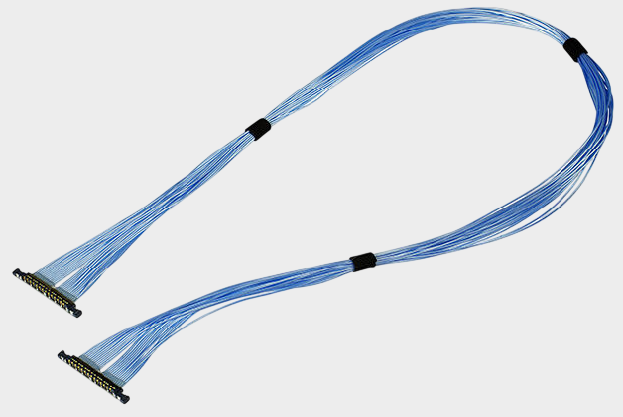
The core advantage of extremely thin coaxial cables lies in the formation of a relatively stable coaxial transmission structure by the central conductor and the outer屏蔽层. When the size of the central conductor, the thickness of the insulation layer, or the dielectric material changes, the electric field distribution between the central conductor and the shielding layer will also change accordingly, thereby affecting the characteristic impedance and the propagation state of high-speed signals. For the ultra-fine specification of AWG#44, even minor changes in manufacturing dimensions may be more apparent in the proportion of the entire cable, so the conductor diameter, the outer diameter of the insulation layer, the shielding layer structure, and the overall outer diameter of the cable all need to maintain good consistency. This I-PEX engineering drawing 81467-100B-02-D specifically stipulates the use of AWG#44, 50Ω, Blue Micro-Coaxial Cable, and completes a 40Pin connection using 40 wires. Therefore, in the process of compatible replacement manufacturing, it is not enough to just achieve "AWG#44 the same"; it is also necessary to match the cable structure in combination with the target impedance and high-speed signal requirements. Otherwise, even if the connector can be normally inserted, there may be differences in signal integrity.
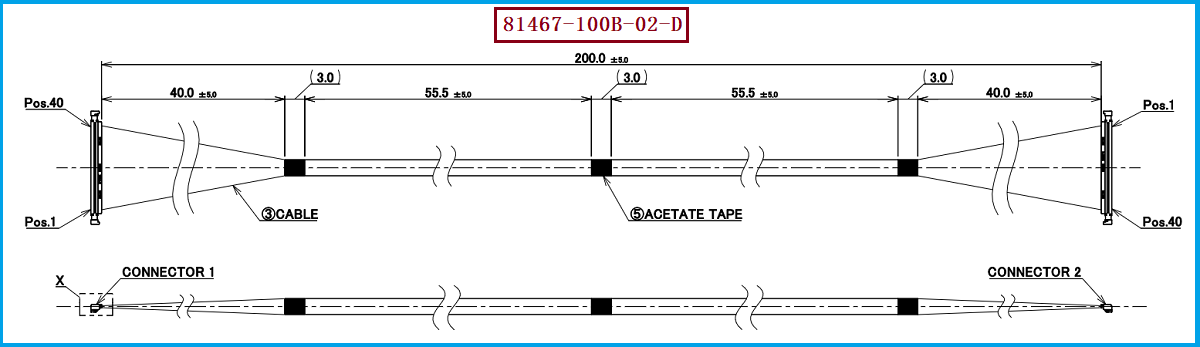
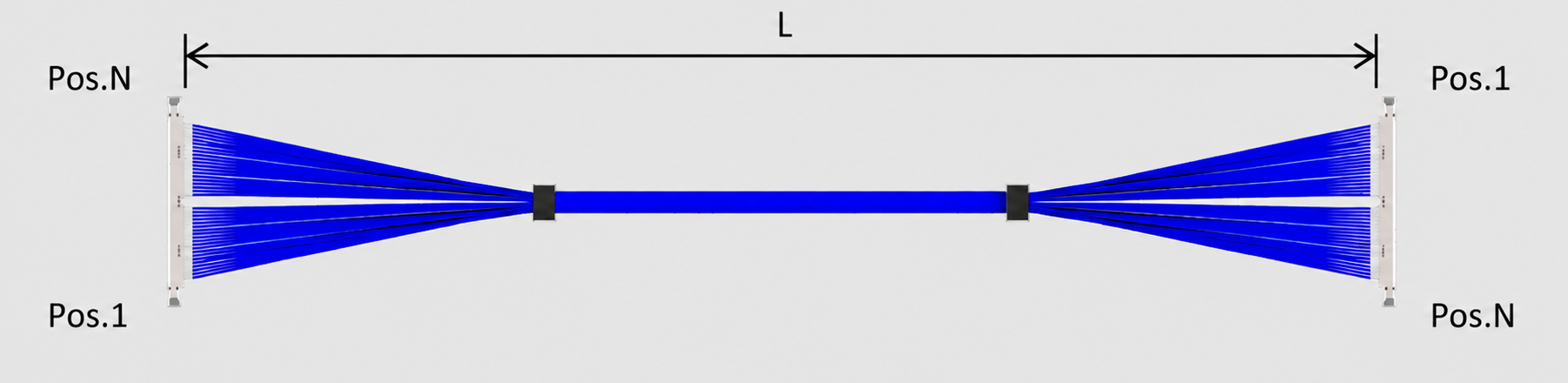
From an engineering application perspective, the central conductor mainly affects the conductor resistance, current carrying capacity, and high-frequency transmission loss; the insulating layer participates in determining the capacitance per unit length and propagation characteristics; and the outer屏蔽 structure not only carries the anti-interference function but also participates in forming a complete transmission structure. Therefore, in high-speed signal environments, it is necessary to comprehensively consider impedance consistency, insertion loss, return loss, crosstalk, and shielding continuity, and cannot simply improve a certain performance by increasing or decreasing the conductor size. The official materials of CABLINE®-UA II provide a reference transmission speed of 5Gbps/lane NRZ, and list reference applications such as USB 3.1 Gen1, V-By-One HS 1.4, HDMI 1.3, eDP, and MIPI; at the same time, this series adopts a 0.3mm Contact Pitch, Vertical Right Angle structure, and supports 26/32/40/50Pin. For engineers, this means that when designing or replacing 81467-100B-02-D, the "conductor structure-insulating structure-shielding structure-connector termination" should be evaluated as a complete high-speed signal channel, rather than just comparing the wire diameter and length.
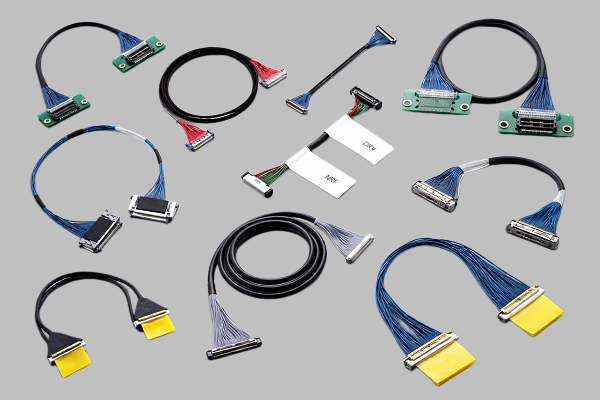
For the selection or domestic-compatible alternative of I-PEX 81467-100B-02-D, procurement personnel and engineers recommend first confirming the product part number, 40Pin structure, 200mm length, 1-N termination method, and core information such as AWG#44, 50Ω Micro-Coax, and confirming that the cable end connector is 20497-040T-30. The official model information of I-PEX clearly lists 81467-100B-02-D as "40pin micro-coaxial 44AWG L=200mm 1-N" cable assembly. During actual alternative development, further verification of Pin Mapping, connector termination dimensions, cable arrangement, shielding continuity, and impedance requirements should be conducted to avoid the situation of "connectors with the same model but inconsistent electrical performance". For projects requiring domestication, second supplier development, or bulk procurement, our company can provide: I-PEX 81467-100B-02-D compatible alternative cable assembly solutions, which can be designed around the combination of 20497-040T-30 + AWG#44 for extremely fine coaxial cable manufacturing, and length, pin count, termination structure, and cable parameter matching will be conducted according to customer drawings and actual assembly requirements.
“Without the consent or authorization of this site, no one shall reproduce, reprint, distribute, cite, change, broadcast or publish the content in whole or in part in any form, nor shall there be any other violation of the copyright of this site.