


Categorization:Harness Component
For engineers and procurement personnel, there is no fixed answer to the typical attenuation rate of ultra-fine coaxial cables that applies to all types of wire. Attenuation is usually expressed in dB/m or dB/100m and varies with increasing frequency, thinner wire, and longer transmission distances. Especially for ultra-fine coaxial cables like AWG44, in GHz-level high-speed signal environments, conductor loss, dielectric loss, shielding structure, and impedance consistency all contribute to insertion loss. Therefore, determining whether a ultra-fine coaxial cable is suitable for high-speed transmission cannot be based solely on the AWG specification, but should be evaluated comprehensively by combining "frequency + wire length + characteristic impedance + wire structure + connector". For the I-PEX 82898-100B-02-D, the official drawings clearly specify the use of 40 AWG#44, 50Ω Micro-Coaxial Cable, with a cable length of 300mm, but no fixed dB/m attenuation value is specified in the cable assembly drawings. Therefore, actual projects should be based on the specific high-frequency test data of the wire material.
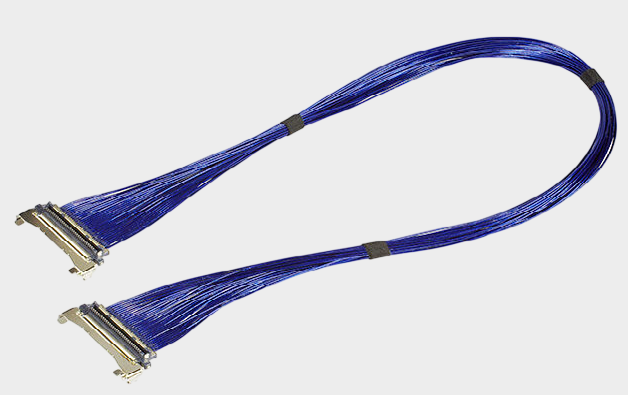
I-PEX 82898-100B-02-D is a 40Pin ultra-thin coaxial cable assembly from the CABLINE®-UA II series, using AWG#44, 50Ω ultra-thin coaxial cable, length 300mm, 1-N structure, with a compatible cable end connector model of 20497-040T-30, and connector pin spacing of 0.3mm. According to I-PEX official data, CABLINE®-UA II uses a 0.3mm contact pitch and vertical right-angle structure, and the reference transmission speed is marked as 5Gbps/lane NRZ; at the same time, the official also provides single-ended and differential SI test data. It should be noted that 5Gbps/lane is the reference transmission capability of the series and does not mean that "82898 can guarantee 5Gbps lossless transmission under any system conditions". For relatively short internal connection distances such as 300mm, the accumulated attenuation generated by the cable itself is usually easier to control than long-distance wiring, but at GHz-level signals, attention still needs to be paid to insertion loss, return loss, crosstalk, and impedance continuity.
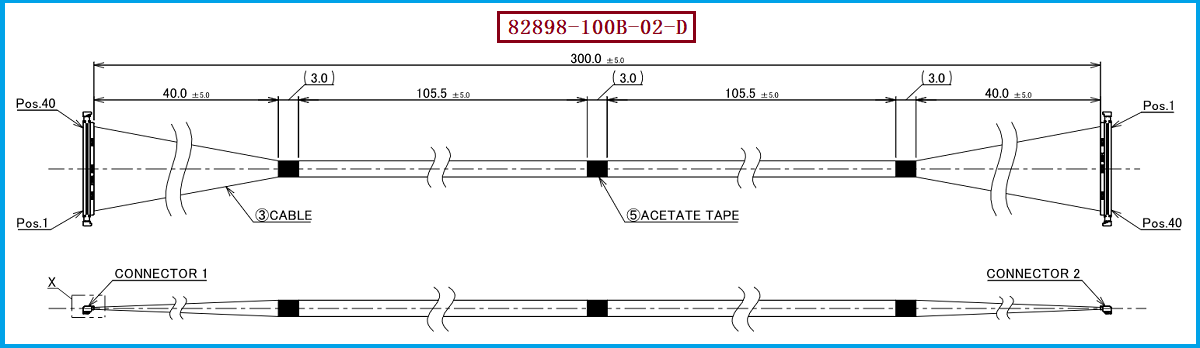
In actual design, the attenuation of extremely fine coaxial cable materials can be simply understood as "attenuation per unit length × actual length". For example, if a certain cable material is tested to have an attenuation of X dB/m at the target frequency, then the theoretical attenuation of a 300mm section of the cable is approximately X × 0.3 dB. However, the actual insertion loss of the complete cable assembly also needs to include the testing of both connectors, termination structures, and PCB transition sections. Therefore, for an 82898-100B-02-D type 40Pin, AWG#44, 50Ω, 300mm high-speed cable assembly, engineers should not only ask "how many Gbps can this cable run" when selecting the cable, but should also further require suppliers to provide SI data such as Insertion Loss (插入损耗), Return Loss (回波损耗), impedance, and crosstalk at the target frequency. For purchasers, it should also be avoided to simply substitute based on "AWG44, 300mm, 0.3mm Pitch", but to confirm that the electrical performance and termination structure of the substitute cable can meet the requirements of the original design. The official I-PEX product page also explicitly states that the SI test report is one of the technical documents for CABLINE®-UA II.
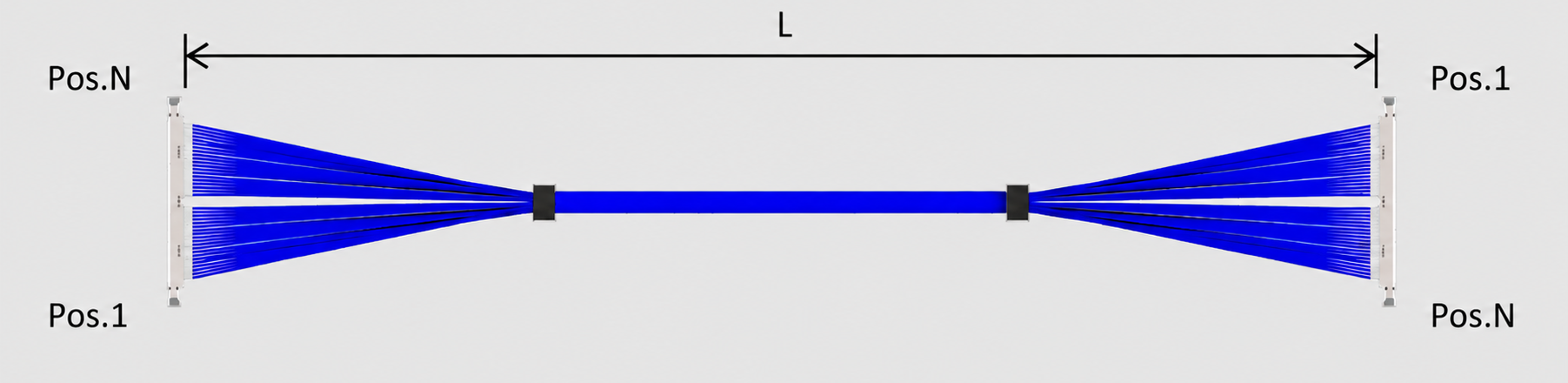
If the original device uses the I-PEX 82898-100B-02-D, when looking for compatible or alternative ultra-thin coaxial cable assemblies, it is recommended to prioritize checking the 40Pin quantity, 300mm length, 1-N connector orientation, AWG#44, 50Ω, and connector model 20497-040T-30, and also confirm the connector pin spacing to be 0.3mm. The CABLINE®-UA II officially also offers 26P, 32P, 40P, and 50P pin count options, so it cannot be determined solely based on the "UA II series" name whether it can be directly replaced. For high-speed signal applications, further verification of attenuation, impedance, insertion loss, return loss, and crosstalk at the target frequency should also be conducted. Our company can provide I-PEX 82898-100B-02-D compatible alternative cable assembly solutions, which can be matched and developed according to the customer's existing cable assembly connectors, Pin count, AWG specifications, impedance, length, termination orientation, and application space, providing engineers with sample verification and bulk production ultra-thin coaxial cable assembly solutions.
“Without the consent or authorization of this site, no one shall reproduce, reprint, distribute, cite, change, broadcast or publish the content in whole or in part in any form, nor shall there be any other violation of the copyright of this site.