


Categorization:Harness Component
One, timing skew problem caused by inconsistent line length
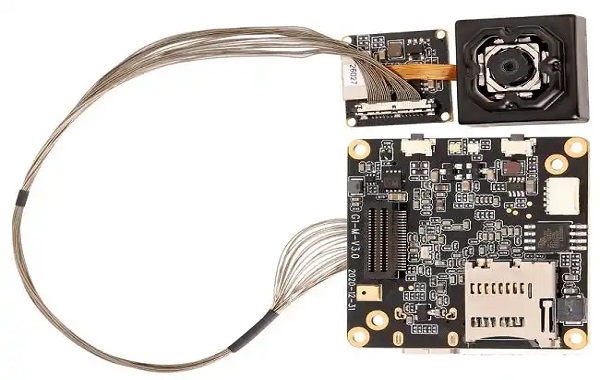
The propagation speed of high-speed signals in extremely thin coaxial cables is usually about 70% to 80% of the speed of light, which means that the signal is extremely sensitive to physical length changes. In multi-channel parallel interfaces, if there are differences in the length of the lines between different channels, it will introduce inconsistent propagation delays (Skew). When the speed reaches several Gbps or even higher, even a few millimeters of length difference may result in picosecond-level delay deviations, directly destroying the time alignment of the data at the receiving end. This problem is particularly common in camera module and AI data collection systems, manifested as frame misalignment, data jitter, or intermittent packet loss, and is often difficult to detect in the early stages.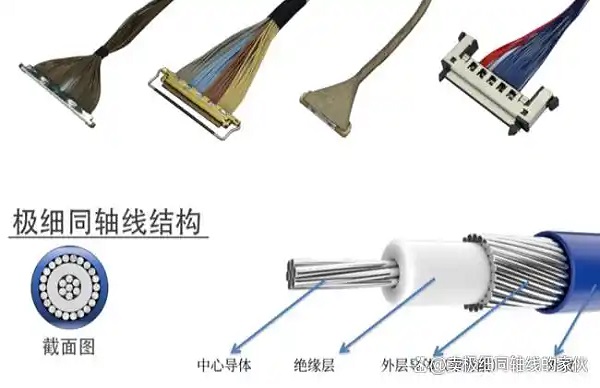
Differential signal imbalance and decreased anti-interference capability
In high-speed differential systems such as MIPI, LVDS, and SerDes, ultra-thin coaxial cables are usually used in pairs. Their original design intention is to enhance anti-interference capability through strict electrical symmetry. However, when the lengths of the two lines are not consistent, the differential signal cannot maintain ideal phase and amplitude matching, and some differential energy will be converted into common-mode noise. This not only weakens the system's ability to suppress external interference but also increases its electromagnetic radiation level, leading to deterioration of the EMI index. At the whole machine level, this problem is often directly reflected in the increased difficulty of EMC testing, even requiring the modification of harness or structural design.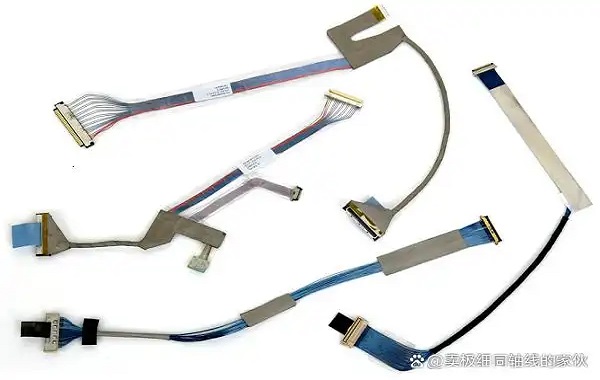
Impedance discontinuity and signal reflection superposition
The extremely thin coaxial cables usually take 50Ω or 45Ω as the target characteristic impedance to ensure the smooth transmission of high-speed signals. However, in systems with multi-segment cables or multiple interface connections, if the cable lengths are inconsistent, there are often hidden impedance discontinuities at connectors, transition areas, or bending points. When high-speed signals pass through these locations, the reflected signals will superpose with the main signal, causing echo noise and cumulative jitter, which ultimately manifests as eye diagram contraction, increased jitter, and rising bit error rate. Compared with single link issues, this kind of reflection often has randomness, making system debugging more difficult.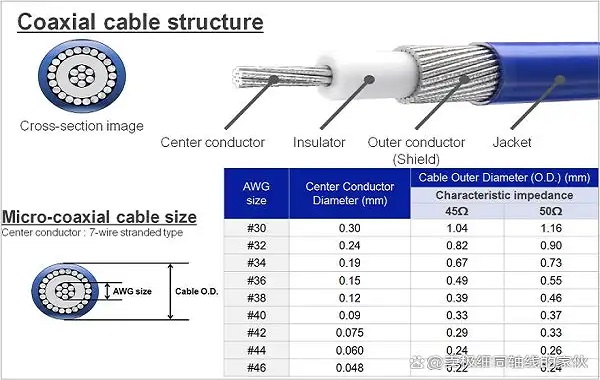
“Without the consent or authorization of this site, no one shall reproduce, reprint, distribute, cite, change, broadcast or publish the content in whole or in part in any form, nor shall there be any other violation of the copyright of this site.