


Categorization:Harness Component
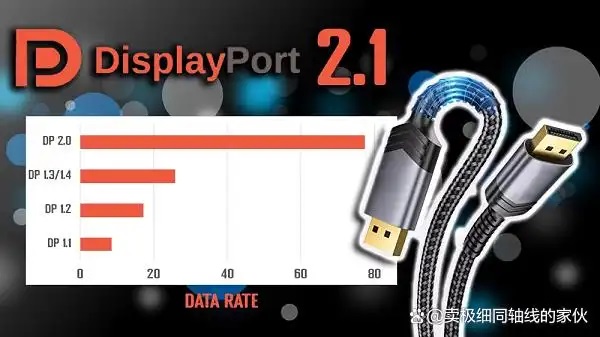
High-speed Challenge between DP2.1 and UHBR20
The DisplayPort 2.1 standard introduces three speed grades: UHBR10, UHBR13.5, and UHBR20, with UHBR20's total bandwidth reaching 80 Gbps. Such high-speed data transmission places extremely high requirements on signal integrity, cable loss, and anti-interference performance. Any minor reflections, crosstalk, or impedance mismatches can lead to a decline in signal quality, thereby affecting image stability and refresh rate performance. To this end, VESA has launched the DP80 certified cable to ensure reliable transmission in UHBR20 mode. However, actual tests show that as cable length increases or frequency rises, signal loss will significantly increase, so high-speed transmission not only depends on the interface chip but also on the cable's own structure and performance.
The characteristics of extremely fine coaxial beam
Extremely fine coaxial cable束 is a miniature coaxial structure wire material, usually using conductors as fine as AWG 40 or finer, with extremely low loss, excellent shielding characteristics, and precise impedance control. It can minimize high-frequency loss to the maximum extent, with each signal line having an independent shielding layer, effectively reducing EMI and crosstalk. At the same time, its outer diameter is extremely thin, making it very suitable for high-density wiring in space-limited devices such as laptops and VR headsets. Its frequency response is stable, and it can maintain excellent signal integrity even at transmission rates of several tens of Gbps. Compared with traditional twisted pair cables or ordinary cable bundles, extremely fine coaxial cables have significant advantages in high-speed and high-frequency environments, making them the ideal choice to ensure DP2.1 UHBR20 performance.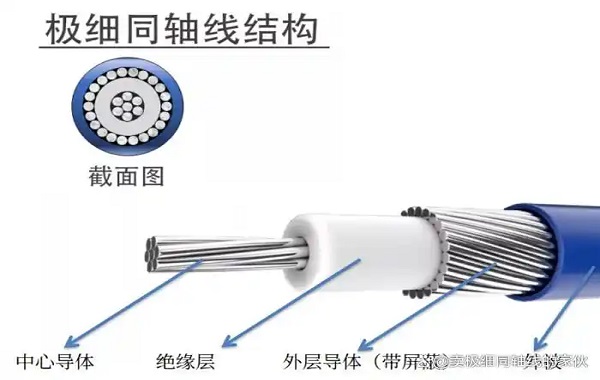
Is DP2.1 mandatory to use ultra-fine coaxial cable?
Although ultra-fine coaxial cables are not the only choice, they are almost essential in scenarios where the highest performance of DP2.1 is pursued. For example, when delivering uncompressed output at 8K@60Hz or 4K@240Hz, ultra-fine coaxial cables can significantly reduce high-frequency loss, improve signal integrity, and ensure the system passes the DP80 or future DP80LL certification. For systems operating in UHBR10 or UHBR13.5 modes, with shorter cables or less interference, ordinary high-quality cables can also meet the requirements. However, if the device is expected to have higher signal margin and future expandability, ultra-fine coaxial cables are still the preferred choice. They can ensure signal stability and reliability in high-speed, high refresh rate, and high-resolution states, and are a safe design strategy for high-bandwidth and high-reliability equipment.
“Without the consent or authorization of this site, no one shall reproduce, reprint, distribute, cite, change, broadcast or publish the content in whole or in part in any form, nor shall there be any other violation of the copyright of this site.